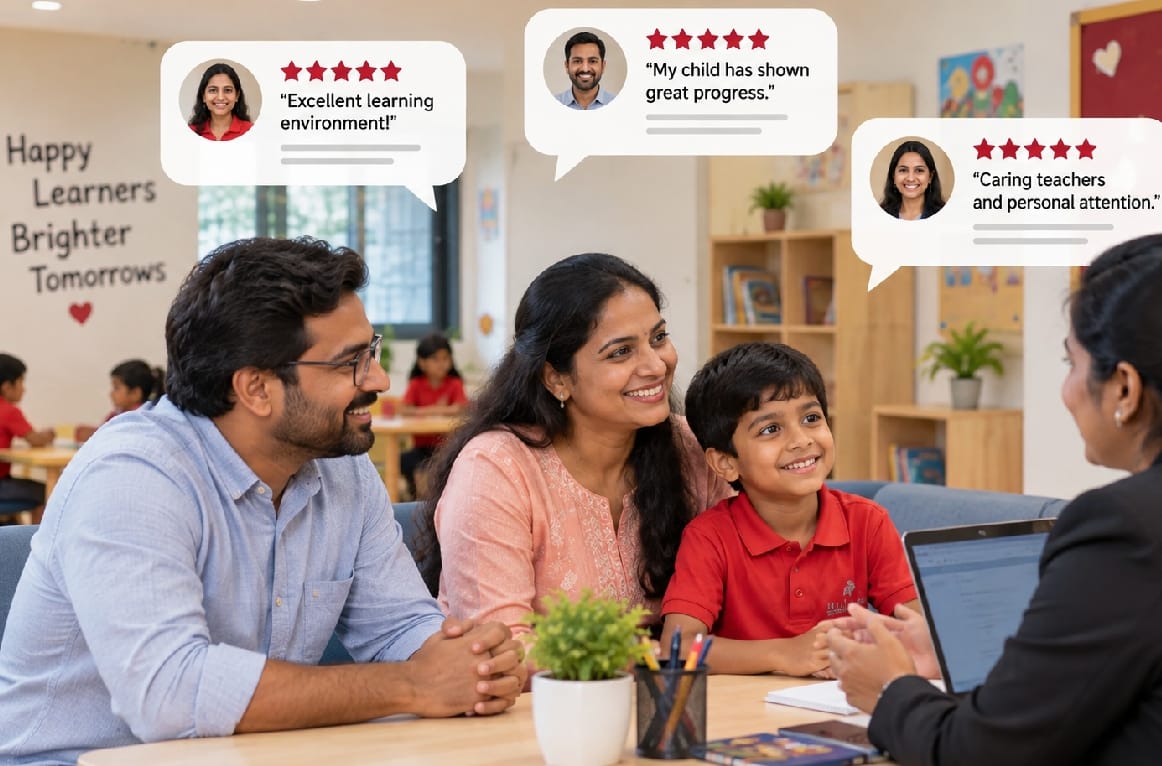
Word of mouth still decides most school choices in Warangal and Hanamkonda. When families start looking, the first question is rarely about curriculum. It’s almost always this: what do other parents say? This guide collects the themes that keep coming up when parents talk, so you can weigh them for yourself.
Key Takeaways
- → Parents in Warangal and Hanamkonda most often talk about teaching quality, safety, and how quickly children settle.
- → Families describe visible change after admission: more confidence, more questions at home, stronger participation in activities.
- → The surest test of any review is a campus visit where you watch children and talk to staff yourself.
What Do Parents in Warangal and Hanamkonda Talk About Most?
Listen across enough conversations and the same few themes come up again and again. Parents talk about whether their child feels safe and known at school. They talk about teachers who remember small details, about transport, and about a day that balances study with play.
Two cities share one habit. Most families in this belt first hear about a school from someone they trust. A relative, a neighbour, or a colleague whose child is already enrolled. That’s why the themes below matter. They’re the ones people repeat to each other over tea.
Curiosity about teaching shows up too. Families ask how lessons run, how progress is measured, and whether the school follows a recognised framework. Parents in both cities compare options carefully, which is why our IB, CBSE and Cambridge guide gets so much use.
What Changes Do Families Notice After Their Child Joins Skill Stork?
Ask parents what changed after admission and the answers cluster around the child, not the school. Children settle faster than many parents expect, especially in the early years. They come home with stories about the day, not complaints about it.
Confidence appears early. Parents describe children who speak up, ask questions at home, and volunteer for stage events without being pushed. With younger children, the shift often shows in small independences: managing their own bag, their own shoes, their own routine. That doesn’t happen by accident.
The early years run on a play-based, largely homework-free model. Families curious about that choice can read why a bagless, homework-free start helps young children. Older children meet more structure, and parents of senior students describe a different outcome: growing clarity about the future.
What Worries Do Parents Raise Before Choosing Skill Stork?
Every family arrives with questions, and the honest ones say so out loud. The table below lists the concerns that come up most, alongside the response families usually hear.
| Common parent concern | How Skill Stork responds |
|---|---|
| Will my child settle after a change of school? | Younger children join through a gentle, staggered settling-in, and class teachers check in daily through the first weeks. |
| Is early years becoming too academic too soon? | The early years stay play-based, bagless and mostly homework-free; structured academics begin at the right age. |
| Can my child move between CBSE, IB and Cambridge later? | All three programmes run on one campus, so switching is a guided conversation rather than a leap into the unknown. |
| How safe is the day, from drop-off to pick-up? | Parents hear about campus security, verified transport, and staff who are trained for travel and field trips. |
| What if my child feels stressed or needs extra support? | Well-being is part of the school week, not an afterthought, and teachers are expected to notice changes early. |
One point is worth repeating. These responses describe how the school actually runs, and the fastest way to test them is to visit and watch. Parents who dig deeper often start with the step-by-step admissions guide, which runs from first enquiry to day one.
Still weighing what other parents say? Talk to the admissions team and hear the same answers for your child’s situation.
How Do Parents Describe Teaching and Daily Care at Skill Stork?
Teaching quality is the most repeated theme in parent conversations across both cities. Parents describe teachers who know children by name and by habit. Teachers notice when a child goes quiet, and they call home with good news, not just concerns.
That personal attention sits on top of a structured curriculum. CBSE families know their child follows the board’s published framework for each grade. International families follow Cambridge or IB expectations, and parents can check the published CBSE curriculum for themselves.
Daily care matters just as much in these conversations. Parents mention meals and rest, how staff handle a scraped knee or a tearful morning, and how updates reach home. It’s the unglamorous stuff that builds trust over a school year.
Which Non-Academic Skills Do Families Mention Most?
Academic progress earns the headlines, but parents spend just as long talking about the rest of the day. The table below groups the skill areas that come up most often and the changes families describe.
| Skill area parents mention | What families say they notice |
|---|---|
| Communication and confidence | Children speak up in class and volunteer for stage events without much coaxing. |
| Creativity in music, art and making | Children keep drawing, building and experimenting once they’re home. |
| Sports and movement | Children look forward to sports periods and come home tired in a good way. |
| Digital and future skills | Children explain how things work and ask why more often than before. |
| Independence and routine | Children manage bags, timetables and homework habits with less hand-holding. |
The through-line is easy to miss until a parent says it out loud. Children are learning skills that never appear on a report card. India’s National Education Policy 2020 pushes schools toward holistic development over rote recall. Families say they notice the difference in how their children talk about school.
It’s the combination parents praise most: a day with room for both. Anyone curious about the creative side can read how music and art shape child development. The school’s sports programme also has a quiet following among parents who value movement.
Why Do Parents Recommend Skill Stork to Other Families?
Referrals are the quiet scoreboard. Parents tell us they’ve sent relatives and neighbours to Skill Stork. Few compliments carry more weight than that. Push a little on the reasons and three answers come back.
The child is known, not processed. The day balances academics with sports, arts and rest. And the school communicates, so parents rarely feel out of the loop. Those three threads run through nearly every conversation we hear.
For families with older children, the recommendation shifts toward outcomes. Parents talk about university preparation with a calm that’s easy to hear. Our overview of how Skill Stork prepares students for global universities explains the approach. International pathways get a mention here too, since the Cambridge programme is recognised by universities worldwide.
Parents on the Hanamkonda side bring up distance less than you’d expect. Many say the daily drive is worth it. This look at why an international school works for growing Hanamkonda captures the reasoning families share.
How Skill Stork Turns Parent Feedback Into Change
Listening only matters when it changes something. Parent conversations feed into how orientation runs, how events are scheduled, and how the next term is planned. When a parent raises something on a visit or at a meeting, it doesn’t vanish into a file.
Well-being deserves a special mention. Parents increasingly ask how schools protect emotional health. Skill Stork’s work on mental health and emotional support in school reflects that.
How Can You Hear What Parents Really Think?
Reviews are someone else’s story, and they help only so far. The fastest way to test Skill Stork for yourself is a campus visit on a working day. Children don’t perform all day, so what you see in classrooms, corridors and the playground tells you plenty.
Bring your questions with you. Ask how your child would settle, which programme fits, what a normal day looks like. The admissions team answers directly, and they’ll point you to published parent guides if you’d like to read more first.
Parents who want the full picture usually start with the CBSE admission guide for Warangal families. Then they book a visit. Here’s the honest part: what you see and hear on campus will tell you more than any review.