Mid-term exams bring the first real assessment pressure of the school year. For most children, that pressure is manageable if the weeks before it are organised. It becomes a problem when preparation starts three days out, when sleep drops, and when a parent’s anxiety arrives before the exam does. Here is what actually helps.
Key Takeaways
- → Start preparation two to three weeks out in short daily blocks. Spaced practice beats cramming for the same total hours (Dunlosky et al., 2013).
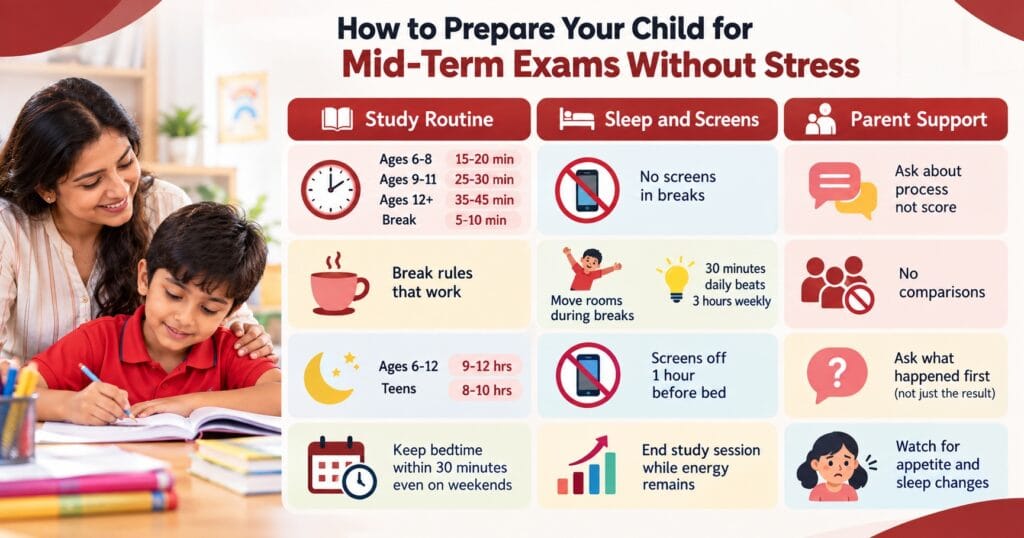
- → Match session length to age: 15 to 20 minutes for ages 6 to 8, up to 35 to 45 minutes for ages 12 and older, with real breaks between blocks.
- → Protect sleep above all else. Children aged 6 to 12 need 9 to 12 hours, and sleep is when the day’s learning is consolidated (AASM, 2016).
- → Talk about process, not scores. Asking what felt solid and what felt rushed gives a child something actionable.
When Should Mid-Term Preparation Actually Start?
Preparation should start about two to three weeks before the first exam, in short daily blocks rather than long weekend sessions. Spaced practice outperforms cramming consistently in learning research, and the gap widens for children whose attention spans are still developing.
The reason is how memory works. Revisiting material across several days strengthens recall far more than reading it repeatedly in one sitting. Research on spaced retrieval practice shows that students who review over four short sessions retain substantially more than those who study for the same total time in one block (Dunlosky et al., review of learning techniques, 2013). The technique is rated among the most effective of the study methods tested.
Three weeks works for most mid-term syllabi. That gives roughly 20 days and enough slack for a bad week, illness, or a topic that needs extra time.
A simple rule for parents: if the timetable is out, the plan should exist within a day. Starting early reduces the total hours needed, not just the stress.
How Long Should a Child Study in One Sitting?
Study session length should match the child’s age. As a rough guide, 15 to 20 minutes for ages 6 to 8, 25 to 30 minutes for ages 9 to 11, and 35 to 45 minutes for ages 12 and above. After each block, take a genuine break of 5 to 10 minutes.
The short-block approach fits how attention works. A child who studies for 90 minutes straight usually spends a large part of that time only partly focused. Four 20-minute blocks with breaks produce more completed work.
Breaks should not involve screens. A break spent on a phone does not restore attention the way a physical or unstimulating break does. Water, a walk, a snack, or simply moving to a different room works better.
End the session while the child still has energy. Stopping at a natural point leaves the work feeling unfinished but achievable. Pushing until exhaustion produces resistance the next day.
Consistency beats intensity here. Thirty focused minutes every day outperforms three hours on a Sunday, and it is far easier to sustain through the exam period.
What Should a Study Routine Look Like at Home?
A study routine works best when it is anchored to a fixed time and a fixed place. The brain starts associating that slot with focused work within about a week.
Pick a time after a rest and a snack, not immediately after school. Most children need 30 to 60 minutes to decompress before they can concentrate. Evening slots work if the child is a morning person, but avoid starting after 8pm.
Keep the study space free of clutter and separate from where the child relaxes. A shared dining table is fine. The requirement is consistent location and minimal distraction, not a dedicated room.
Have a written plan visible to the child. A simple weekly grid showing which subject each day covers removes the daily negotiation about what to study. It also lets the child see progress.
Include subjects the child finds easy alongside the harder ones. Starting every session with the most difficult topic builds avoidance. Rotate so hard subjects come after a short warm-up.
Review yesterday’s material for five minutes before starting something new. That single habit does most of the work that spaced practice is supposed to do.
How Much Sleep Does a Child Need During Exams?
Sleep is the single most important variable during the exam period, and it is the first thing sacrificed. Children aged 6 to 12 need nine to twelve hours a night. Teenagers need eight to ten hours (American Academy of Sleep Medicine, 2016).
Cutting sleep to study more is a net loss. Sleep is when the brain consolidates what was learned during the day. An hour of revision bought by an hour of lost sleep is usually an hour of revision that does not stick.
Protect bedtime during the exam weeks. Keep it within 30 minutes of the normal time, even the night before an exam. A late night before an exam reduces recall and increases errors the next morning.
Stop screens at least an hour before bed. Blue light and stimulating content both delay sleep onset. If the child studies on a device, switch to paper or finish earlier.
Watch for sleep problems as a signal. A child who cannot settle, or who wakes repeatedly in the weeks before exams, is often carrying anxiety that needs addressing directly rather than more study time.
How Do You Handle Screen Time During Exam Weeks?
Screen time during exam weeks should be reduced but not eliminated. Removing it entirely tends to backfire, because it turns screens into a forbidden reward and increases fixation on them.
Set the terms in advance rather than negotiate daily. A workable arrangement is screens after study is complete, with a fixed cut-off before bed. Write it down so it is not re-argued each evening. Guidance on children’s screen use recommends consistent limits set by the family rather than by the child’s request (World Health Organization, 2024).
Keep the total moderate. A complete ban creates resentment and often pushes use into secret late-night sessions, which damages sleep more than a managed allowance would.
Separate entertainment from study use. If the child uses a tablet for research, that should not count against the entertainment allowance, but the device should still leave the room at bedtime.
Model the same rule. A child who is told to put a phone away while a parent scrolls nearby learns that the rule is not real. Exam weeks work better when the household reduces screen use together.
What Should Parents Say About Results?
Parents should talk about effort and process before the results arrive, not after. Framing the conversation early removes some of the pressure that builds during the exam period itself.
Avoid predicting outcomes. Statements about what score is expected turn every paper into a test of whether the child met a parent’s number. That pressure usually reduces performance rather than raising it.
Ask about the process instead. Which topic felt solid, which felt rushed, what would help next time. Those questions keep the focus on learning and give the child something actionable.
Respond to a poor result in the same way as a good one at first. Ask what happened before offering anything. A child who expects a reaction tends to hide information, which removes the chance to help.
Keep comparisons out of it entirely. Comparison with a sibling or classmate adds pressure without adding information. The only useful comparison is against the child’s own previous work. Child development guidance from the CDC makes the same point about milestone comparisons, noting that children progress at individual rates.
Watch for signs that pressure has gone too far. Loss of appetite, sleep disruption, unexplained stomach aches before school, or refusal to discuss exams are signals to reduce the load rather than add to it.
What Puts a Child in a Better Position?
Three things make the most difference, and all three are structural rather than motivational.
First, an early start with short daily sessions. It lowers total hours and removes the end-of-period panic.
Second, protected sleep. It is the mechanism by which studying turns into recall, and it is the first thing to go under pressure.
Third, a calm home. Children read their parents’ anxiety accurately. A household that treats exams as a normal part of the term produces less pressure than one that treats them as an event.
None of this requires a tutor or a longer study day. It requires a routine that is decided early, followed consistently, and adjusted when something breaks.
If you want to understand how we support learning and wellbeing through assessment periods, see our parent resources and school admission enquiry, read our guide to helping your child sleep better before school, or review our screen time guidelines by age. Our teachers work with families through every assessment cycle.