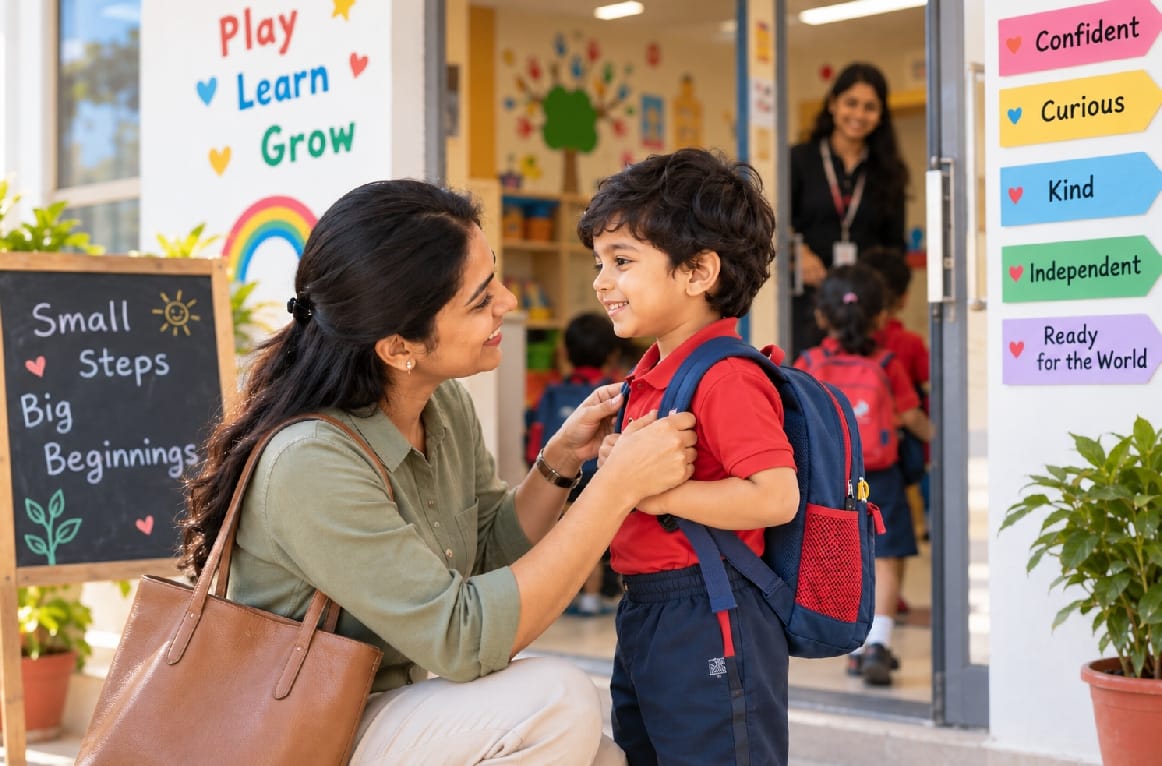
Preschool enrolment across India has climbed quickly. The ASER 2024 survey found 77.4% of the country’s three-year-olds were enrolled in a pre-primary institution, up from 68.1% in 2018 (ASER Centre, 2024). So if you’re in Warangal weighing nursery admission, you’re not early.
The useful question isn’t the calendar, though. It’s whether your child has the skills, the routine and the confidence to enjoy the day. Below are the readiness signs that matter, how to handle teary drop-offs, and what teachers watch for.
Key Takeaways
- → Nursery readiness is about skills, not a birthday. In 2024, 77.4% of India’s three-year-olds were already in pre-primary (ASER Centre).
- → Watch four domains: language, social interest, motor control and self-help. The CDC records the skills 75% of children have by a given age.
- → Separation anxiety is normal and usually eases by about age 3. Short, calm drop-offs beat long goodbyes.
Can a 2.5 Year Old Go to Nursery?
Yes, in most cases. India’s National Education Policy 2020 places the Foundational Stage at ages 3 to 8, with three years of preschool before Class 1 (Ministry of Education, NEP 2020). Plenty of schools admit children from 2.5 for nursery, as long as they can handle a short separation and tell an adult what they need.
Age is a rough proxy, though. A 2.5-year-old who says “water”, follows “bring your shoes”, and settles with a teacher will usually start better than a 3.5-year-old who has never spent an hour away from family. By two, most children run, kick a ball, join two words and notice when someone else is upset (CDC milestones by 2 years).
Don’t rush the decision, and don’t delay it either. Once you’ve decided, our Warangal KG admission guide covers the dates, documents and registration steps.
What Are the Signs Your Child Is Ready for Nursery?
In the first few years of life, more than 1 million new neural connections form every second (Center on the Developing Child, Harvard University). Readiness gets built through everyday experience, not rushed. Look for a cluster of signs.
- Separates from you for half an hour without distress that lasts all morning.
- Follows a two-step instruction, like “pick up the block and put it away”.
- Tells you what they need, even if it’s only two words.
- Notices other children and moves toward them.
- Manages small self-help tasks: a cup, a spoon, pulling shoes off.
- Calms down within about 10 minutes of a goodbye, a milestone the CDC lists for 3-year-olds.
No child ticks every box on the same day. Readiness is a direction of travel, not a test.
Readiness Signs by Domain, Not by Birthday
Nursery readiness isn’t one skill. It’s four domains working together, and teachers watch all four. The CDC’s milestone checklists, revised in 2022, mark a skill as expected only when 75% or more of children can do it by that age, which is a realistic benchmark.
| Domain | Signs to look for at 2.5 to 3.5 years | Why nursery needs it |
|---|---|---|
| Language and communication | Two or three word phrases, follows simple instructions, says their own name | Settles faster when needs are met |
| Social and emotional | Notices other children and joins them, copies adults, recovers after a goodbye | Needs turn-taking and quick recovery |
| Motor skills | Runs, kicks a ball, climbs steps, stacks blocks, holds a crayon | The day is all movement and making |
| Self-help and independence | Eats with a spoon, drinks from a cup, signals when they need the toilet | Teachers can’t do it all for everyone |
If one row looks thin, resist the urge to drill it. Pick that domain and fold it into ordinary days: more talk at meals, more carrying, more practice standing on one foot.
Not sure which signs to work on first? The admissions team can talk through your child’s routine and what the early years day looks like.
How Do You Handle Separation Anxiety at Nursery Drop-Off?
Expect some tears, and treat them as normal. Separation anxiety usually peaks between 9 and 18 months and has mostly faded by age 3. Only about 4.1% of children show it at a clinically significant level (NIH StatPearls). Short flare-ups are common when a child starts school for the first time.
What helps most is a goodbye your child can predict:
- Keep it short. Thirty seconds with the same words beats a long, emotional send-off.
- Never slip away. Children who are told you’re leaving learn to trust the next goodbye.
- Hand your child to the teacher, then go. They’ve done this a hundred times.
- Name a return time your child understands, like “after your snack”.
- Keep mornings boring. Same route, same order, same bag.
If tears last more than half an hour at every drop-off for several weeks, or your child stops eating and sleeping well, talk to your paediatrician. Early support works faster than waiting.
Building a Nursery-Ready Routine at Home
Give yourself three to four weeks. Sleep is the anchor. The American Academy of Sleep Medicine recommends 10 to 13 hours per 24 hours, including naps, for children aged 3 to 5, with consistent bed and wake times (AASM, 2016). A rested child separates more easily.
| Routine area | What it looks like | Why it helps |
|---|---|---|
| Wake-up and bedtime | Same times every day, weekends included | A rested child settles faster |
| Meals and snacks | Sit-down meals at roughly the times school uses | Predictable hunger keeps afternoons calm |
| Practice separations | Short stays with a grandparent, first 30 minutes, then an hour | Your child learns that you come back |
| Independent jobs | Your child carries their own bag and opens their lunchbox | Small jobs build confidence |
Two habits do most of the heavy lifting. Our guide to screen-time limits by age covers the hour before bed, and this piece on helping your child sleep better before school walks through the bedtime routine.
What Do Schools Observe in a Nursery Readiness Interaction?
Most preschools don’t test, they observe. In a typical interaction your child plays while a teacher watches a few things: whether they respond to their name, follow a simple instruction, stay calm when you step aside, and show interest in other children.
Teachers notice the small stuff too. Can your child hold a crayon? Stack a few blocks? Ask for water? None of this needs letters or numbers, and a child who arrives drilled on reading has no real edge. India’s National Curriculum Framework for the Foundational Stage sets out this play-based approach for ages 3 to 8 (NCERT, 2022).
They’re assessing you as well, so expect questions about your child’s sleep, what upsets them, and who collects them in the evening.
When Is It Better to Wait Another Year?
Sometimes waiting is the better call, and the research says the setting matters far more than the date. A 2026 study of 123,256 children found preschool attendance was linked to stronger development in every domain measured, from social and emotional skills to communication (Curtin University, 2026).
The same study found more than one in five children still start school developmentally vulnerable. The goal isn’t a perfect birthday. It’s a good fit. Consider another year if:
- Your child still cries hard for more than half an hour at every drop-off after four to six weeks.
- They can’t yet tell an adult what they need.
- A major change at home, such as a new baby, a move or a long illness.
- A paediatrician has flagged a developmental concern that’s still being assessed.
Waiting isn’t falling behind. A year at home with a steady routine, plenty of talk and short practice separations builds the same skills. Our piece on why the early years shape lifelong learning covers this.
Why Skill Stork’s Early Years Programme Works for Warangal Families
The early years at Skill Stork run on play, not pressure. Classrooms stay bagless and largely homework-free, so a first school experience is about language, movement, making and friendships instead of worksheets. Children join through a staggered settling-in, and class teachers check in with parents daily through the first weeks. The early years programme admissions page explains how the day runs and how to book a visit.
Enquire About Nursery Admission