Parents in Warangal and across India face a constant tension. Academic pressure mounts from every side, and creative subjects like music and art often get squeezed out of the schedule. The assumption is that time spent on creativity is time stolen from real learning.
The research says the opposite. Children who participate in music and art show measurably stronger memory, attention, and problem-solving skills, and the benefits carry into academic subjects like mathematics and language. A 2023 analysis of over 60 studies found consistent links between music training and cognitive skills in children, including working memory and executive function (research review, 2023).
Here’s what parents and schools should know about why creativity isn’t a break from learning, it’s part of it. For families comparing options, our guide to IGCSE vs CBSE explains how different curricula handle creative subjects.
Key Takeaways
- → Music training is linked to stronger working memory, attention, and executive function in children, with benefits that transfer to maths and reading.
- → Art activities develop fine motor skills, visual-spatial reasoning, and emotional regulation.
- → Creative children build confidence and resilience through the freedom to experiment and fail safely.
- → The best schools treat creativity as a core subject, not an optional extra, integrating it across the timetable.
- → Parents can support this at home with simple, low-cost creative routines that take 20 minutes a day.
Why Creativity Matters More Than Ever
The jobs and challenges children will face in 2035 don’t exist yet. The World Economic Forum consistently ranks creativity and critical thinking among the top skills for future work, skills that standardised testing barely measures. UNESCO’s education guidance similarly highlights arts education as essential, not optional.
Meanwhile, technology is automating routine cognitive work. The abilities that remain uniquely human, creative problem-solving, imagination, emotional expression, are exactly what music and art train. A child who can compose, paint, or perform is practicing skills no algorithm can replace.
This isn’t an argument against academics. It’s an argument for balance. The most effective schools pair strong academics with strong creative programs, and the evidence suggests each reinforces the other.
What Music Actually Does to a Child’s Brain
Music is the most studied creative activity in neuroscience, and the findings are striking:
- Working memory, musicians show stronger auditory and visual working memory than non-musicians
- Executive function, playing an instrument trains attention, planning, and self-control
- Language skills, musical training sharpens the brain’s ability to distinguish speech sounds, aiding reading and phonics
- Maths connections, rhythm and pattern recognition in music mirror mathematical thinking
One of the most powerful findings: starting music early and continuing consistently matters more than talent. The brain adapts to training, and the adaptations persist even if the child stops playing later.
Want a school that balances academics and creativity?
How Art Develops Skills Beyond the Canvas
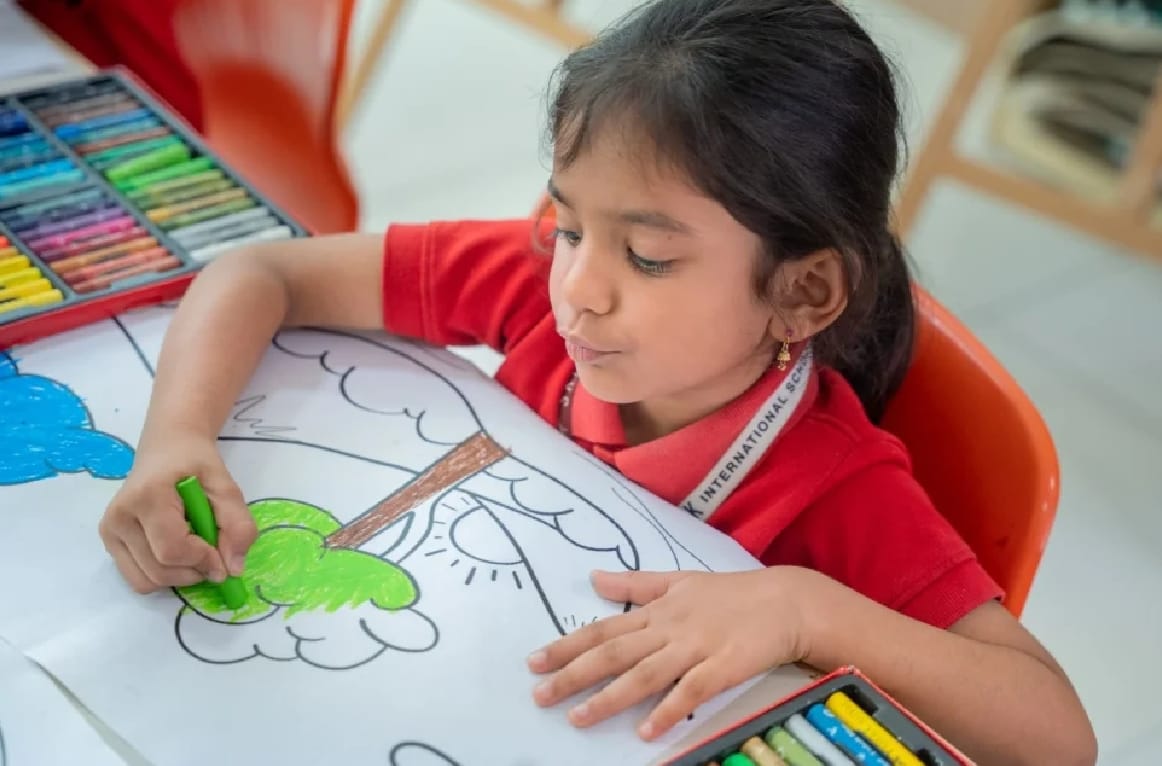
Art often gets dismissed as a hobby, but it’s a serious developmental tool:
- Fine motor skills, holding brushes, cutting, moulding clay builds hand strength and coordination that prepares children for writing
- Visual-spatial reasoning, drawing and construction train the brain to understand shapes, proportions, and relationships, skills used in maths and engineering
- Emotional regulation, art gives children a safe channel for big feelings they can’t yet verbalise
- Decision-making, every painting involves choices: colour, composition, what to keep or change
- Persistence, finishing a piece teaches children to work through frustration to completion
None of this happens from a single art class. It compounds over years of regular creative practice, which is why consistency matters more than occasional grand projects.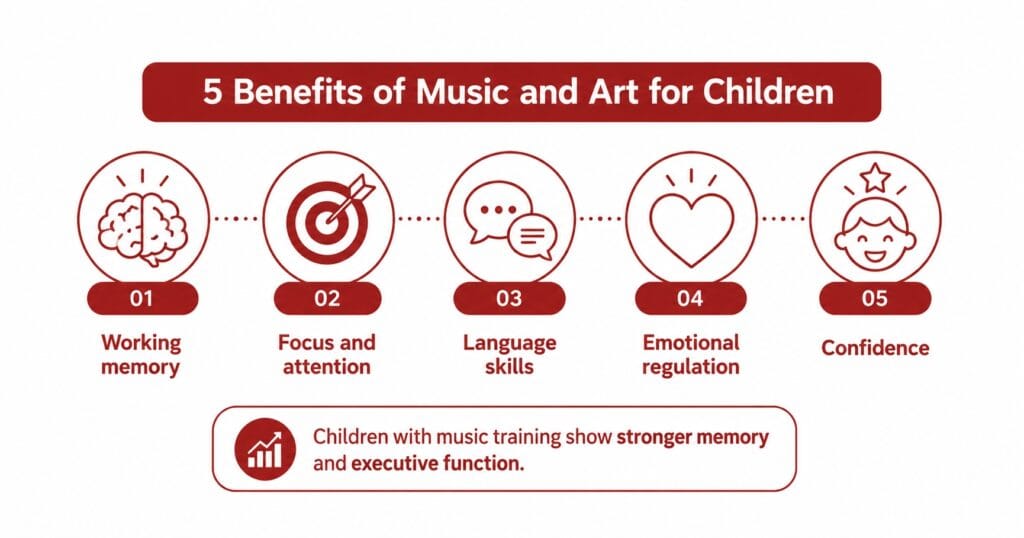
The Confidence Factor
For parents weighing school choices, it helps to see how creative programs differ between curricula, which we break down in our comparison of IB vs CBSE vs Cambridge.
There’s a quieter benefit that may matter most. In a world of marks and comparisons, art and music give children a space where there isn’t one right answer. A child can experiment, make mistakes, and still create something that’s genuinely theirs.
That experience builds confidence in a way grades never can. Children who feel competent in one domain carry that self-belief into others. The shy child who finds their voice in choir, the restless one who loses themselves in painting, these transformations are common in schools that take creativity seriously.
What a Creativity-First School Looks Like
Not every school can afford full music and art departments. But the schools that do it well share some patterns:
- Daily creative time, short sessions most days, not just a Friday period
- Integration, teachers link art to history, music to maths, creativity across subjects
- Display and celebration, children’s work is shown, performed, and valued publicly
- Choice, students pick from music, art, drama, and crafts based on interest
- No comparison, creative work is assessed on effort and growth, not ranked
Parents visiting schools should ask: how much time is actually devoted to creativity each week, and how is it valued?
The honest answer from experienced educators: schools that treat creativity as a core subject tend to produce more engaged learners overall. Creative activities give children something to look forward to, a reason to be excited about school, and a place where they can shine outside the marks sheet. For children who struggle academically, that creative anchor can be the difference between loving school and dreading it.
The best schools also connect creativity to what children are learning elsewhere. A history lesson becomes a drama performance. A maths concept becomes a rhythm pattern. Science diagrams become art projects. This cross-pollination deepens understanding in both directions, which is why integrated creative teaching produces stronger results than isolated weekly art periods. Our international school guide covers what to look for when evaluating options in the Warangal region. The answer tells you a lot about the school’s philosophy.
How Parents Can Support Creativity at Home
You don’t need expensive instruments or classes to make a difference:
- 20 minutes of music a day, even singing along or clapping rhythms trains the same neural pathways
- Keep art supplies accessible, paper, crayons, and paints within reach invite spontaneous creation
- Ask open questions, “tell me about your drawing” instead of “what is it?”
- Create a display wall, celebrating their work tells children it matters
- Model it, draw, sing, or make something alongside them; children mirror what they see
The goal isn’t to raise professional artists. It’s to raise children who think creatively, express themselves confidently, and carry those skills into every part of their lives.
One thing parents often miss: creative time also builds attention span. In an age of endless screens and short videos, sitting with a painting or an instrument for 30 focused minutes is training the same sustained-attention muscle children need for study. Schools and parents who protect creative time are indirectly protecting academic focus too.
And it doesn’t take much to start. A box of crayons, a few songs in the car, a story told together at bedtime, these small consistent moments compound exactly the way reading aloud does. Creativity isn’t an expensive add-on. It’s a daily habit with outsized returns.
Find a School That Values Creativity
At Skill Stork International School in Hanamkonda, creative development is built into the curriculum, not bolted on as an afterthought. Music, art, and performance are regular parts of the school week, complementing strong academics.
See how we balance academics and creativity.