Key Takeaways
- → The World Health Organization recommends no screen time for children under 2 and under 1 hour daily for ages 2-5.
- → For school-age kids, quality matters more than the clock; educational content beats passive watching.
- → Indian children average more screen time than WHO limits suggest, especially after the pandemic.
- → Nighttime screens disrupt sleep more than daytime use, so set a device curfew.
- → Consistent family rules beat one-off limits; kids follow habits they see modelled at home.
Why Do Screen Time Guidelines Matter in 2026?
Screens are everywhere, and kids are using them younger than ever. A 2025 report from India’s National Commission for Protection of Child Rights found that 65% of Indian children aged 8-16 use the internet daily. That’s a lot of screen exposure to manage.
The concern isn’t the device itself. It’s what excessive, unstructured screen time displaces: sleep, outdoor play, face-to-face conversation, and focus. Studies link heavy screen use with poorer sleep, attention difficulties, and higher rates of anxiety in children.
The good news? Guidelines exist, and they’re more flexible than many parents think. The goal isn’t to eliminate screens but to use them deliberately, with age-appropriate limits and quality content.
What Are the Official Screen Time Limits by Age?
Health organisations have published clear age-based guidance. The World Health Organization’s guidelines for young children are the most widely cited, and India’s own health bodies align with them.
| Age Group | Recommended Limit | Notes |
|---|---|---|
| Under 2 | None, except video calls | Interactive face-to-face play is far better |
| 2-5 years | Under 1 hour/day | High-quality content, co-viewed with an adult |
| 6-10 years | 1-2 hours/day | Educational content preferred; homework time separate |
| 11-14 years | 2 hours/day | Balance with school, sport, and sleep |
| 15+ years | Consistent limits | Focus on sleep protection and online safety |
These are starting points, not strict laws. A child using screens for school projects, music practice, or creative work is different from hours of passive scrolling. Adjust based on your child’s age, temperament, and needs.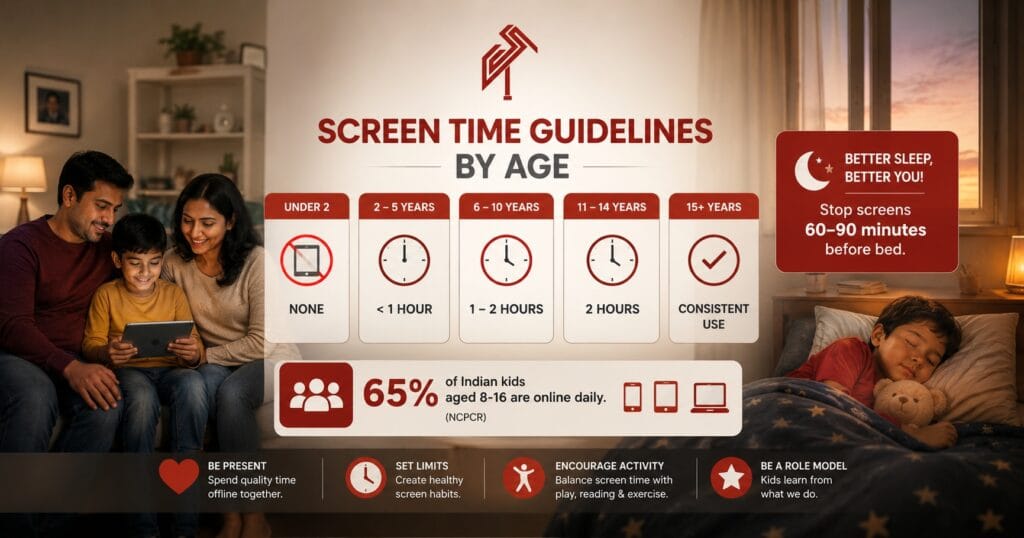
How Much Screen Time Do Indian Kids Actually Get?
Real-world usage often exceeds the guidelines. Surveys across Indian cities show school-age children averaging 2-4 hours of recreational screen time daily, with a jump on weekends. After the pandemic, many families never returned to pre-2020 limits.
The gap matters because the risks scale with time. Children exceeding 3 hours of daily recreational screen time show measurably higher rates of sleep problems and attention complaints. Parents who set clear limits early report fewer battles later.
So the real question isn’t “what’s the perfect number?” It’s “how do we build screen habits that hold up when school, homework, and friends compete for attention?”
What Does Quality Screen Time Look Like?
The clock is only half the story. An hour of an educational app or a documentary with discussion beats three hours of autoplaying short videos. Quality screen time is active, purposeful, and often shared.
Look for content that makes your child think or create. Coding apps, puzzle games, science videos, and interactive learning platforms build skills. Passive content, like endless cartoons or algorithm-fed short videos, entertains but doesn’t develop much.
Co-viewing changes the outcome too. When parents watch alongside and discuss what they see, children understand and retain more. That’s why the American Academy of Pediatrics guidance emphasises shared screen time for younger kids rather than solo use. For younger children, even fifteen minutes of shared watching with a conversation afterwards beats an hour of solo viewing. Ask simple questions while you watch: what did you notice, what would you do differently, was that character’s choice a good one? These small exchanges turn passive viewing into active learning and build the media-literacy skills children carry into their teen years.
How Do Screens Affect Sleep?
Screen use near bedtime is the single biggest sleep disruptor. The blue light from screens suppresses melatonin, and engaging content keeps the brain alert. Children who use devices in the hour before bed fall asleep later and sleep less deeply.
The fix is a device curfew. Stop screens 60-90 minutes before bedtime, charge devices outside the bedroom, and make the hour before sleep screen-free with reading or quiet play. This one change improves sleep more than any other screen rule.
Morning matters too. Kids who check devices right after waking start the day in reactive mode. A screen-free first hour sets a calmer tone for the whole day.
What Are Practical Screen Rules for Indian Families?
Simple, consistent rules work better than complicated systems. Here are six that families in India report using successfully:
- Set a daily time budget and show it on a visible chart.
- Keep mealtimes and family time screen-free.
- Charge all devices in the parents’ room overnight.
- Use parental controls, but explain why they exist.
- Model the behaviour — put your own phone down during family time.
- Offer engaging alternatives: sport, board games, books, outdoor play.
The last point matters most. Screens often win because they’re the easiest option. When alternatives are accessible and fun, kids choose them more often without a fight. That’s also why the rules should be visible rather than remembered: a printed chart on the fridge with the daily time budget, device-free zones marked, and a family agreement signed together gives kids something concrete to follow. When children help set the rules, they’re far more likely to honour them than when limits arrive as sudden commands.
How Do I Handle Screen Battles with My Child?
Expect resistance when you introduce limits. Children adapt faster when rules are consistent, explained, and applied by everyone in the household, including parents.
Use a calm, firm tone and connect limits to values, not punishment. Instead of “no more phone,” try “we protect your sleep, so devices stay downstairs at night.” Frame screen time as something to earn and balance, not a forbidden treat.
If battles are constant, review what your child is watching. Sometimes the pull isn’t the screen itself but a game, a friend group, or FOMO. Addressing the underlying need reduces the fight more than tightening limits alone. A child glued to a multiplayer game may actually be chasing connection with friends, not the game itself. A child watching short videos late at night might be avoiding homework anxiety. When you identify the real need, you can offer a better substitute: a family game night, a phone call with the friend, or a calm homework routine with you nearby. The screen was never the enemy; the unmet need was.
When Should Parents Be Concerned About Screen Use?
Most screen habits are manageable with boundaries. But some patterns signal a need for help: if screen use interferes with schoolwork, sleep, or friendships; if your child is distressed when screens are removed; or if you suspect exposure to inappropriate content.
A school counsellor or child psychologist can help when screen use is tied to anxiety, attention issues, or social withdrawal. Schools like Skill Stork that emphasise student wellbeing treat digital balance as part of overall health, not just a discipline issue.
The Bottom Line
Screen time guidelines give you a starting point, not a verdict. Match the limits to your child’s age, prioritise quality over the clock, protect sleep with a device curfew, and model the habits you want to see.
Skill Stork blends digital literacy with strong student wellbeing support, so kids learn to use technology wisely. Learn about Skill Stork admissions for 2026-27 or explore how we support student wellbeing and digital infrastructure on campus.