Most parents can tell you their child’s reading level. Far fewer can say how well their child handles being disappointed. Yet that second skill decides how the first one gets used for the next fifty years. Emotional intelligence in children is teachable, and the teaching happens in ordinary moments.
Key Takeaways
- → Child EQ development is not a trait you either get or miss. A meta-analysis of 213 school programmes and 270,034 students found these skills can be taught, with an 11 percentile point gain in achievement (Durlak et al., 2011).
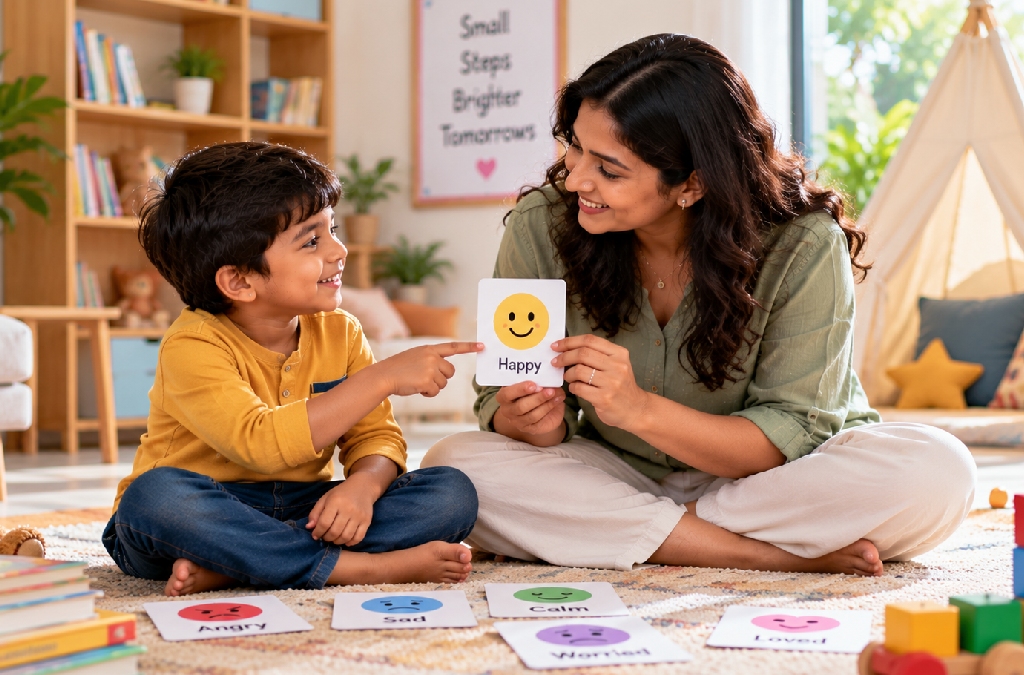
- → Teaching kids emotions works in small, repeated moments: naming a feeling, waiting out a wave, repairing after a fight.
- → Naming an emotion lowers activity in the amygdala, the brain’s alarm centre, so words come before strategies (Lieberman et al., 2007).
- → Meltdowns are the curriculum, not a failure of it. Coach the next attempt instead of punishing the last one.
What Is Emotional Intelligence in Children?
Emotional intelligence is the ability to notice a feeling, understand what caused it, and choose what to do next. In a child, that looks less like insight and more like behaviour: waiting a turn, asking for help, calming down after a lost game. CASEL groups these into five teachable areas: self-awareness, self-management, social awareness, relationship skills and responsible decision-making (CASEL).
None of the five arrives on a timetable. A five-year-old who names sad and mad but not frustrated is doing well. A nine-year-old who can say “I was embarrassed, so I shouted” is doing something more advanced. The adult job stays the same at every layer: help the child notice, name and choose.
Watch the emotional range the way you watch speech. The CDC publishes social and emotional milestones by age and advises parents to look at patterns, not one hard afternoon (CDC).
Why Does EQ Matter as Much as IQ?
Because thinking skills only pay off when a child can regulate the state they think in. The strongest evidence is a pooled result, not a slogan. Across 213 school programmes and 270,034 students, those who received social and emotional teaching showed better skills, attitudes, behaviour and academic performance, an 11 percentile point gain in achievement (Durlak et al., 2011).
A later review widened the sample to 424 studies from 53 countries and 575,361 students, and found the same direction of effect, with benefits still visible six months after a programme ended (Yale School of Medicine, 2023).
IQ without regulation looks like a bright child who shuts down in an exam hall. Regulation without challenge looks like a calm child who never stretches. Parents do not have to choose between them, because the two borrow from each other daily.
Which Emotional Skills Should You Teach at Each Age?
Match the lesson to the stage, because a four-year-old and an eight-year-old need different scripts for the same feeling. Asking a seven-year-old to “use your words” mid-rage rarely works. A small practised step at the level the child already reaches does.
| Age | What you can teach | What it looks like |
|---|---|---|
| 2 to 3 years | Naming big feelings | “You are cross because the tower fell.” |
| 4 to 5 years | Waiting and turn taking | A visible timer, one short wait, then praise it. |
| 6 to 7 years | Cause and repair | “What happened first? What could you say tomorrow?” |
| 8 to 10 years | Reading other people | Guess the feeling behind a face, then check the guess. |
If your child starts school this term, our nursery readiness checklist for Warangal parents sets out the social milestones teachers look for first.
Looking for a school where emotional development sits beside academics on the timetable? The Skill Stork team can walk you through the admission process and what a school day looks like.
Five Everyday Habits That Build Emotional Intelligence at Home
The habits that move the needle are small, free and repeatable. None of them needs a worksheet. All of them need an adult who is not in a rush, which is the hard part.
- Name your own feelings out loud. “I got frustrated in traffic and took a breath.”
- Ask about the sequence, not the verdict. “What happened before you pushed him?” gets a story.
- Keep a calm corner with three options: water, a cushion, paper.
- Praise the repair, not the record. “You went back and said sorry” teaches more than “you never fight”.
- Rehearse tomorrow. One sentence your child can use beats a lecture after the fact.
These habits overlap with the ones that build friendship, because the same muscles are involved. Our guide to helping your child make friends and develop social skills covers the peer side.
How Do You Teach Kids to Name Their Emotions?
Teach the label first, because a named feeling is already a smaller feeling. In brain imaging work, putting feelings into words reduced activity in the amygdala, the brain’s alarm centre, while raising activity in regions linked to regulation (Lieberman et al., Psychological Science, 2007).
Start with four labels and add detail as the child grows: happy, sad, angry, scared. Then widen to the useful middle ground, such as frustrated, embarrassed, left out, nervous. That finer vocabulary is what lets a child say “I am nervous, not angry” in a school corridor.
Timing matters more than wording. Name the feeling while it is small, not only when it has become a crisis. A running commentary on ordinary moments does the work: “You look pleased with that tower. You kept going after it fell.”
Why Meltdowns Are Teachable Moments, Not Behaviour Problems
A meltdown is a nervous system event, and the thinking brain is offline while it happens. Reasoning, warnings and consequences aimed at a child mid-flood land on a brain that cannot process them. That is why a calm child who “knows better” repeats the same thing a week later.
Handle it in three steps. Keep everyone safe and say almost nothing. Name the feeling once the wave drops, without a lecture. Then, the part parents skip, come back to it later the same day and rehearse the next attempt.
Look at the pattern too. Frequency, time of day and trigger tell you more than intensity does. A child who falls apart at four every afternoon is often tired or hungry, not defiant.
How Can Schools Build Emotional Intelligence Every Day?
Through the timetable, not through assemblies. A school builds EQ when children work in small groups, reflect on how a project went, and have an adult who notices a bad morning. That has to sit inside the day, because a fortnightly lesson fades.
The IB Primary Years Programme runs from ages 3 to 12 and states that it “prioritizes people and their relationships to build a strong learning community” (International Baccalaureate). Cambridge International describes its primary learners as confident, responsible, reflective, innovative and engaged (Cambridge International). CBSE sets the syllabus and assessment pattern for most Indian schools, including the foundational years (CBSE).
At a school visit, ask three questions. How many adults share the youngest class? How often do children work in small groups? What happens, step by step, when a child cries and cannot settle? Compare how the boards structure those years in our guide to IB vs CBSE vs Cambridge in 2026.
When Emotions Need More Support Than Coaching at Home
Most big feelings respond to time, sleep and practice. A few need a professional, and waiting rarely helps. The useful question is not “is my child sensitive” but “is my child stuck”, meaning the same difficulty at the same intensity for months.
Ask for help if a child cannot be soothed by any adult, avoids school most mornings, or loses a skill they had. Start with the class teacher, then a paediatrician. Interview preparation tests the same muscles: our guide to preparing your child for a school interview and assessment shows what schools watch for.
Ready to look at a school that treats emotional development as part of the curriculum? Start your admission enquiry today.