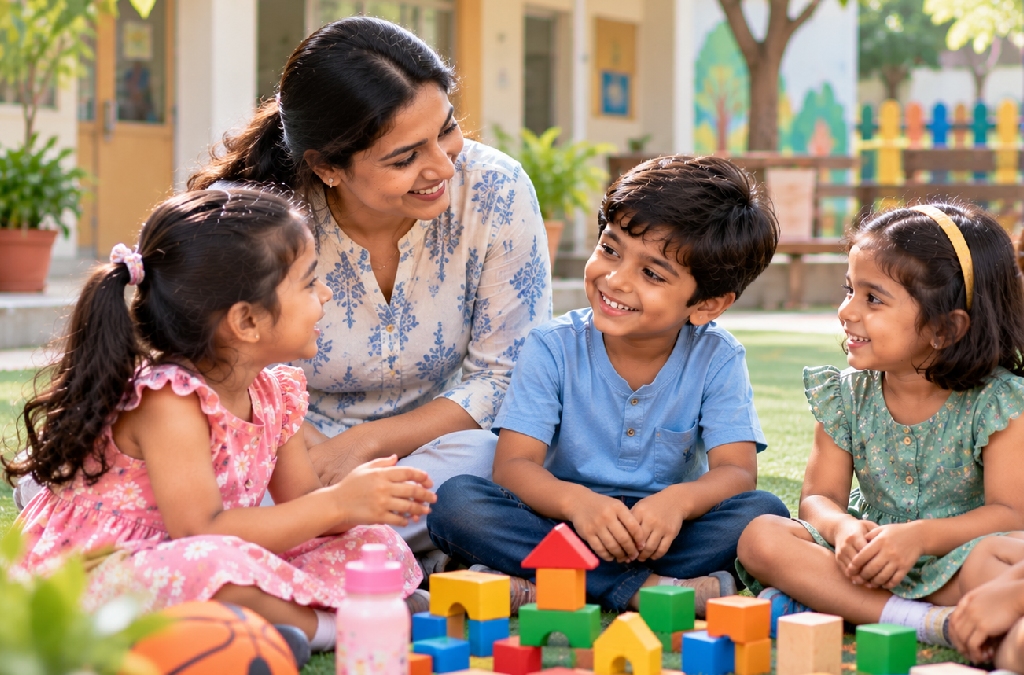
Children learn to make friends the way they learn to walk: through many small, wobbly attempts, with an adult close by. Nobody teaches a toddler to share by lecturing. They learn it by trying, watching and being coached through the moment.
Social development in children follows a fairly predictable path, though the timing varies from child to child. Here is what to expect at each stage, how to help a child who hangs back, and when a friendship problem needs a teacher.
Key Takeaways
- → Peer relationships in the early years predict adult outcomes. Popularity with peers and low aggression at age 8 predicted higher occupational status at age 48 in one long-term study (Penn State, 2018).
- → Friendship changes shape every year or so between ages 3 and 8. A child playing beside others at three is on track, not behind.
- → Shy children need smaller steps and rehearsal, not pressure. Practise joining a group at home before trying it in the park.
- → Most friendship troubles are practice problems. Coach the next attempt and rehearse one sentence your child can use tomorrow.
Why Do Social Skills Matter More Than Marks in the Early Years?
Peer relationships in the early years predict adult outcomes far more than most parents expect. In one long-term study, popularity with peers and low aggression at age 8 predicted higher occupational status at age 48 (Penn State Prevention Research Center, 2018). Skills that look like play are doing serious long-term work.
Sharing, waiting, reading a face and repairing a disagreement are the same skills adults use in meetings and marriages. A child who can enter a group without disrupting it gets more practice at everything else, because children teach each other constantly.
How a child plays, speaks and behaves is also a health signal, not just a personality trait. The CDC tracks these as developmental milestones and encourages parents to watch the pattern over time rather than a single bad afternoon (CDC).
What Do Friendships Look Like at Different Ages?
Friendship changes shape roughly every year between ages 3 and 8, and each stage needs a different kind of help from you. A three-year-old who plays beside another child is doing exactly what that age looks like. A six-year-old who negotiates the rules of a game is doing something more advanced.
| Age | What you will see | What helps most |
|---|---|---|
| 3 to 4 years | Plays alongside others, watches and copies, may not share yet. | Short playdates, two children at most, duplicate toys so sharing is optional. |
| 4 to 5 years | Starts playing with others, takes turns with a reminder, tests rules. | Naming feelings and simple scripts such as “my turn next”. |
| 5 to 6 years | Wants a best friend, negotiates rules, may exclude others. | Coaching through exclusion and teaching repair after a fight. |
| 6 to 8 years | Chooses friends by shared interests and fairness. | Clubs and shared activities, with less adult supervision. |
Behind these stages sits a quiet skill: understanding that another person can hold a different belief or want. In a 2025 study of 94 children, 80% of five-year-olds tested before the pandemic passed a simple test of this skill. After the lockdowns, the pass rate fell to 63% (UC Merced, 2025). Play with other children is where that skill gets built.
If your child starts school next term, start with our nursery readiness checklist for Warangal parents. It sets out the social and self-care milestones teachers look for in the first week.
How Can You Help a Shy Child Join In?
Shy children don’t need to be changed. They need smaller steps and some rehearsal. Temperament isn’t a deficit, and a cautious child often becomes a careful observer who joins once the ground feels solid. What helps is teaching the mechanics of joining a group, which adults do automatically and children don’t.
- Practise at home first. Role-play “can I play too?” with a stuffed toy playing the group, and let your child hear you get a no.
- Arrive early at a party or park, so your child meets one child rather than walking into twelve.
- Give one concrete job, such as holding the gate or handing out the balls. A role makes a first sentence easy.
- Coach the second attempt, not the first. “You asked, they said not now. What could you try next?”
- Describe what happened instead of labelling the child. “You were quiet at first, then you joined in” is more useful than “you are shy”.
Children who struggle with goodbyes often settle faster when separation is practised in advance. Our guide to preparing your child for a school interview and assessment covers short practice separations and what teachers watch for.
Wondering whether your child is ready for a school where social confidence is part of the timetable? The Skill Stork team can walk you through the admission process and what to expect.
What Should You Do When Friendships Go Wrong?
Most friendship problems in the early years are practice problems, not personality problems. Children are learning to negotiate, and they get it wrong often. Your job is to coach the next attempt rather than repair the friendship for them, because the repair is the skill.
| What you see | What it usually means | What helps |
|---|---|---|
| One child decides every game | Normal at four and five, unequal by seven | Teach one phrase: “let’s do your idea after mine” |
| Your child is left out of a group | Often about group size, not dislike | Help them find one child, or a smaller setting |
| A friendship suddenly ends | Common, and rarely permanent at this age | Name the feeling, keep routines steady, leave the door open |
| Teasing becomes repeated and targeted | No longer ordinary conflict | Speak to the class teacher the same week, in writing |
When your child comes home upset, ask about the sequence before you reach a verdict. “What happened first? Then what did you say?” Children often leave out the part where they shouted or pushed. A calm retelling usually reveals a workable next step. Then rehearse one sentence they can use tomorrow.
The School Environment Does Half the Work
How a classroom is run matters as much as what happens at home. The IB Primary Years Programme runs from ages 3 to 12. Its framework states that it “prioritizes people and their relationships to build a strong learning community” (International Baccalaureate). That’s a curriculum decision rather than a slogan: group work, shared projects and reflection are timetabled, so social skills get daily practice.
Cambridge International describes its primary learners as confident, responsible, reflective, innovative and engaged (Cambridge International). CBSE sets the syllabus and assessment pattern for most Indian schools, including the foundational years (CBSE). The classrooms differ, but each one gives a child a daily social world to practise in.
Adult attention counts too. At a school visit, ask how many adults share the youngest class and how often children work in small groups. Compare how the boards structure those early years in our guide to IB vs CBSE vs Cambridge in 2026 and our breakdown of IGCSE vs CBSE.
When to Ask for Help With Your Child’s Social Skills
Social anxiety is common enough to name, and uncommon enough that most quiet children do not have it. An estimated 9.1% of US adolescents experience social anxiety disorder at some point in their lives, and 1.3% have severe impairment (NIMH). For a young child, the useful question isn’t “is my child shy” but “is my child stuck”.
- No interest at all in other children by age four or five.
- Cannot follow a two-step instruction or take a turn in a simple game by age five.
- Distress at every goodbye that lasts beyond six weeks.
- A skill your child had, such as chatting with cousins, disappears and doesn’t come back.
Start with the class teacher, who sees your child in a group every day, and then a paediatrician if the pattern holds. Early support is easier than waiting, because a child who is repeatedly rejected can stop trying altogether.
Ready to look at a school that puts relationships at the centre of learning? Start your admission enquiry today.