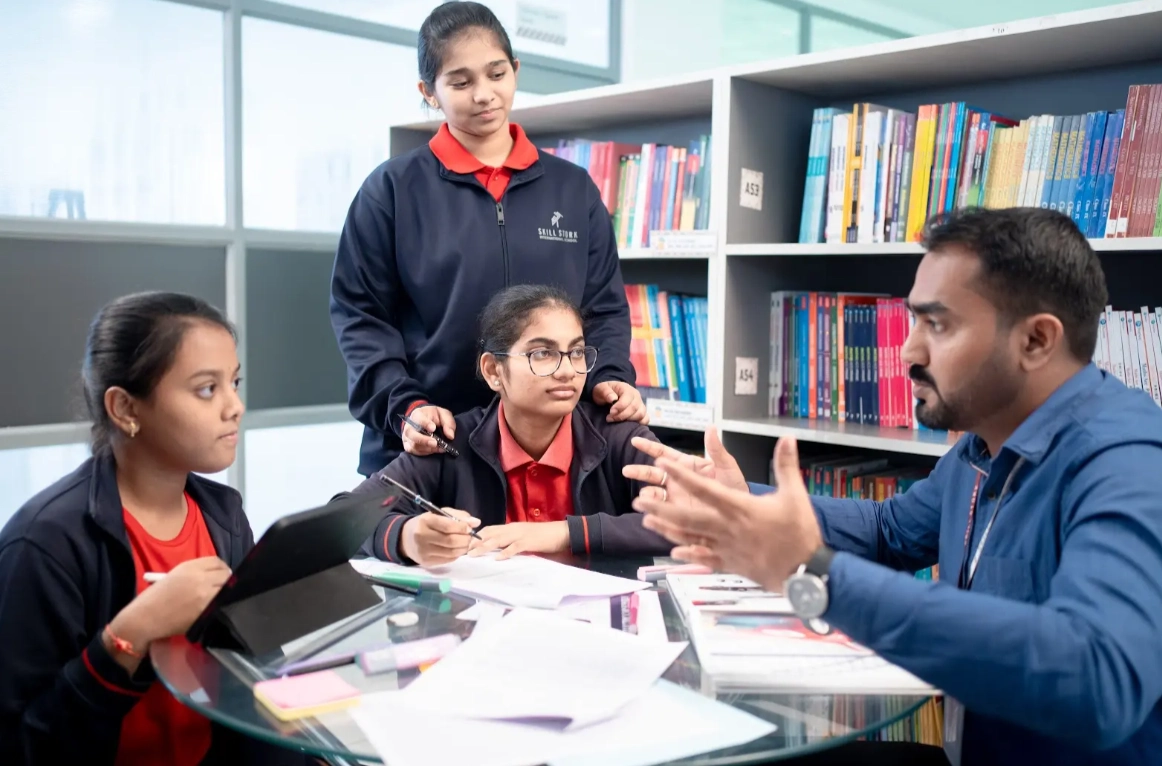
Education in India is at a crossroads. For decades, rote learning and exam-focused teaching have dominated our classrooms. But a quiet revolution is underway — one that puts children’s natural curiosity at the center of learning: inquiry-based learning. At Skill Stork International School in Warangal, we’ve seen how this approach transforms early childhood education and sets children up for lifelong success.
What Exactly is Inquiry-Based Learning?
Unlike traditional methods where teachers deliver information and students memorize it, inquiry-based learning flips the script. It starts with questions — often from the children themselves. Teachers become facilitators who guide exploration, encourage critical thinking, and help students discover answers through hands-on experiences, experiments, and collaborative projects.
In an inquiry-based classroom, you’ll see:
- Children asking “why” and “how” — and being encouraged to seek answers
- Less time spent on worksheets, more on projects and experiments
- Mixed-age groups learning together
- Teachers observing, questioning, and scaffolding rather than lecturing
- Learning that connects to real-world contexts
Why India Needs This Approach Now
India’s educational landscape is diverse and challenging. With over 250 million children in schools, we face a dual problem: high enrollment but low learning outcomes. The ASER reports consistently show that many children in Grade 5 cannot read a Grade 2 textbook or do basic arithmetic. Rote learning hasn’t delivered the results we need.
Inquiry-based learning addresses these gaps by:
- Building genuine understanding — Children remember concepts they discover themselves, not just facts they memorize for exams.
- Developing critical thinking — In a world where AI can provide instant answers, the ability to ask good questions, evaluate information, and solve novel problems becomes paramount.
- Fostering curiosity — Once children learn to love asking questions, they become lifelong learners — capable of adapting to any career or technology shift.
- Improving retention — Active engagement leads to deeper memory encoding and better long-term recall.
The Early Years: When It Matters Most
The first six years of a child’s life are neurologically the most plastic. Brain connections form at lightning speed during this period. Inquiry-based learning leverages this by:
- Stimulating multiple brain regions — Hands-on exploration, sensory experiences, and social interaction create rich neural networks.
- Building executive function — Planning experiments, recording observations, and discussing findings develop working memory, self-control, and flexible thinking.
- Cultivating socio-emotional skills — Collaborative inquiry teaches children to listen, negotiate, share ideas, and resolve conflicts — skills that are more predictive of adult success than IQ scores.
At Skill Stork’s Early Years program, we design environments that invite curiosity. Classrooms are stocked with open-ended materials (blocks, natural elements, art supplies) rather than pre-packaged kits. Outdoor spaces become laboratories for observing nature, measuring plants, and testing physical concepts like balance and motion.
What This Looks Like in a Typical Day
Let’s trace a morning in a Skill Stork kindergarten classroom:
- 8:30 AM — Free exploration. Children choose from provocations set up by teachers: a water table with floating/sinking objects, a seed-planting station, or a construction zone with Recycled materials.
- 9:30 AM — Circle time. A child asks, “Why do leaves change color?” Instead of giving an answer, the teacher says, “That’s a great question. How could we find out?” Children suggest collecting leaves, looking through magnifying glasses, and maybe doing a simple experiment with vinegar (acid) to see changes.
- 10:00 AM — Inquiry projects break out. One group examines leaf structures; another mixes colors to mimic autumn hues; a third measures shadows to understand light. Teachers circulate, asking probing questions: “What do you notice?” “What might happen if…?” “How can we test that?”
- 11:00 AM — Documentation time. Children draw, write, or dictate their findings. The teacher photographs the process. Learning becomes visible — not just for parents, but for the children themselves to reflect on.
This approach naturally integrates literacy and numeracy. Math emerges when children count leaves, measure plant growth, or compare shadow lengths. Language develops as they discuss ideas, write labels, and read books to deepen their inquiries.
Debunking Common Myths
Will my child fall behind in reading and writing without worksheets?
Absolutely not. In fact, children in inquiry-based settings often develop stronger literacy skills because they write and read for authentic purposes — to record a question, share a discovery, or create a book about their project. At Skill Stork, our students produce detailed science journals, design labels for their inventions, and read to find answers to their own questions.
Is inquiry-based learning suitable for children with different learning paces?
Yes, and it’s actually better at meeting diverse needs. Because learning is open-ended and teachers are observant facilitators, each child gets the right level of challenge and support. A child who needs more time to process can explore at their own pace; a child who’s ready for deeper concepts can be given more complex extensions.
How can parents practice inquiry-based learning at home?
Start by answering your child’s questions with another question. If they ask, “Why is the moon following our car?”, instead of just explaining, ask, “Why do you think it’s following us?” Let them explore their own thought process before discovering the answer together.
The Parent’s Role: Extending Inquiry at Home
Inquiry-based learning doesn’t stop at school. Parents can nurture this mindset at home by:
- Answering questions with a question: Instead of “The moon follows us because it’s reflecting sunlight,” say, “What do you think? How could we test that?”
- Providing open-ended materials: blocks, clay, art supplies, natural items.
- Allowing messy, tinkering play: Take things apart, build forts, mix safe household substances under supervision.
- Visiting museums, gardens, markets with a curious attitude — not just for sightseeing, but for noticing, questioning, and investigating.
Why Skill Stork Embraces This Philosophy
As an International Baccalaureate (IB) World School in Warangal, Skill Stork’s pedagogical framework aligns perfectly with inquiry-based learning. The IB Primary Years Programme (PYP) is built around structured inquiry. But even for our CBSE and Cambridge pathways, we’ve integrated inquiry because research shows it yields better outcomes in conceptual understanding, creativity, and problem-solving.
Our teachers are trained in Reggio Emilia-inspired documentation, project-based learning, and design thinking. We believe that the jobs of tomorrow won’t be filled by people who simply know facts — they’ll be filled by those who can ask the right questions, collaborate across cultures, and innovate. Inquiry-based learning is not a pedagogical trend; it’s an essential preparation for the future.
Experience Inquiry-Based Learning at Skill Stork
Visit our campus in Warangal to see inquiry in action. Observe our early years classrooms, speak with our educators, and discover how your child can thrive in a school that values curiosity as much as achievement.
About the Author:
This article was written by the Skill Stork International School faculty to help parents understand the research and practice behind inquiry-based early childhood education. Skill Stork offers IB, Cambridge, and CBSE curricula from Early Years to Grade XII, with a focus on holistic development and future-ready skills.