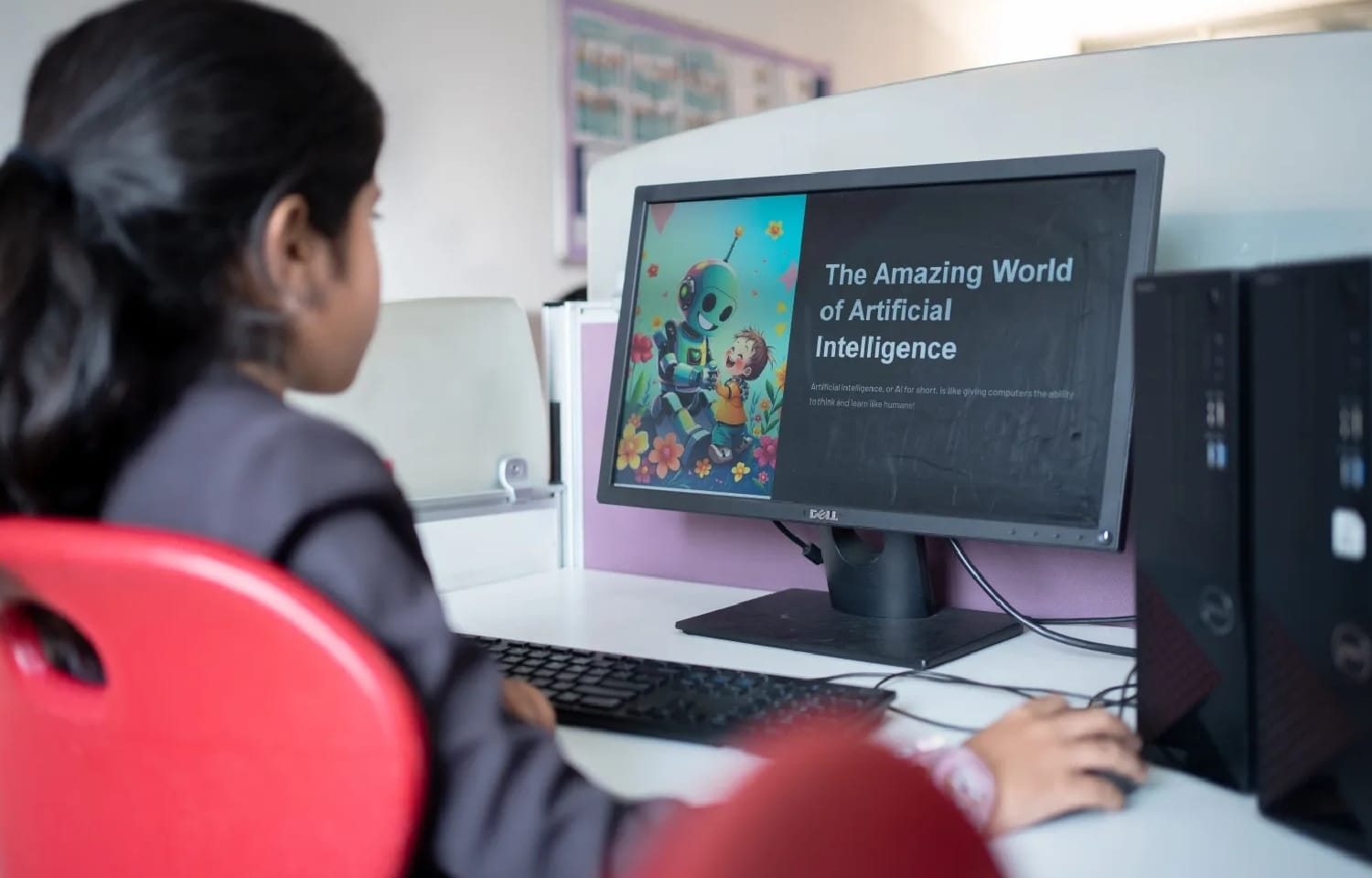
We are currently progressing into a new part of a new cycle of history; the world is transitioning into the age of AI. For parents and educators, the measurement of success in this new era of history is even more difficult to gauge. The construction of education is pivoting towards a more human-centered focus during learning, rather than the acquisition of knowledge.
Education and the systems of learning were designed to produce workers for the industrial economic system. Success for education and learning was determined by one’s memorization, ability to follow systems, and adherence to a specific skill. For example, the education of the previous decades would foster the “human calculator.” Education was focused on developing rote learning skills because of the complexity of human skills.
Fostering education systems in today’s world is even more complex. Education must focus on developing skill sets that are uniquely human and not those that are developing a competing skill, but rather a skill that is developing a sense of direction. The following seven skills are the basis of a strong foundational future for targets of education.
Professional World Requirements: Structural Shift
The world is looking for individuals who are able to direct and charge, not only to simply follow and complete tasks. The demand and necessity are even more “human-centric,” and where this demand is the highest is in the value of human judgment.
The difference is easy to identify, as we directly respond to the requirements of an automated economy to determine what is justified in the traditional education model.
Traditional Education vs. High-Agency Skills
| Focus Area | Traditional Industrial Model | AI-Era Agency Focus |
|---|
| Data Interaction | Fact retrieval and retention | Verification, bias detection, and synthesis |
| Work Methodology | Independent task execution | Collaborative orchestration and tool management |
| Problem Approach | Finding the pre-set “right” answer | Identifying the most impactful “right” question |
| Knowledge Lifecycle | Fixed degree/early-life learning | Continuous, self-directed skill acquisition |
1. Critical Thinking and Discernment of Algorithms
Synthetic media is the up-and-coming frontier, blurring the lines of reality. Critical thinking is important academically, generally in life, it is essential, and for children, it is a tool of survival. Information is plentiful, but often either fake, deliberately misleading, and culled based on an existing bias, or an algorithmic selection of a pre-existing structure.
When we teach discernment, we teach what, and then proceed to the depth of the content, the context, the reasons, the causative factors, the producers, etc. When a child is faced with an AI-driven search engine, the focus is on the data provenance, and we instruct them to ask about the data: who was the provider, what were the biases in the response, and how it can be verified across three independently, human-assessed sources.
When we instill skepticism, we nurture children from consumers of information to analysts, from passive to active. Information is plentiful, and we do not want to instill data capture techniques that manipulate it.
2.Emotional literacy as a career edge
Potential rivals judged on empathy level and emotional intelligence present an edge in the professional world.
Potential rivals judged on empathy level and emotional intelligence present an edge in the professional world.
In sports, collaborative efforts are venues for emotional literacy development. Children discovering loss containment, building, rule negotiations, disappointment, and loss-driven experiences are integrated into emotional literacy preparation. Materials for emotional literacy present the development of emotional literacy, a precedent for loss containment, disappointment, and building emotional literacy in teamwork for driven loss containment.
3.Digital literacy expansion
Darwinian evolution defines modern literacy as social navigation and word processing skills. Mastery of architecture and design skills defines evolution, distinction in literacy.
World literacy relation building is seen as a configurable, non-black-box world. Children’s. Digital world literacy relation. Children’s interest in computer science is not required in world-building, designed architecture, and logic limited to order, definition structures, loop containment, literacy relations, and world-to-math.
Moreover, this includes an understanding of data confidentiality and personal virtual footprint. Informing children about the value of their data helps them choose platforms and data to share more judiciously.
4. Creative Authenticity and Divergent Thinking
AI is a predictive technology at its core. It gathers existing information and forecasts the most probable subsequent data. Synthesis is its forte. Original ideas, however, elude it. This is where the human ability compels its irreplaceability.
The ability to independently and critically solve a problem — divergent thinking — is a muscle that can atrophy. Most conventional education systems applaud and reward convergent thinking, where there is only one correct or accepted answer. Because of this, parents should endorse divergent thinking in children.
Tools of art, writing, and block construction should not have a fixed purpose to allow kids room to be creative and innovative. Children should be bored when not stimulated by a screen, escaping the trap of passive observation and entering the realm of imagination and active engagement.
5. Adjustability and the Learning to Learn
The obsolescence rate of technical knowledge is staggering. Take a language or a software, in five years, the knowledge is irrelevant. The most crucial skill a child can have is to acquire knowledge swiftly.
This requires a shift from a “fixed mindset” to a “growth mindset.” We must praise the strategy and the effort rather than the innate talent. A child who thinks of themselves as “just good at math” can feel like a failure when they do not grasp a new concept immediately. However, if they think they are “good at learning difficult things,” they will tackle new challenges head on and with the needed effort.
Adaptability/ resilience also involves tolerance with uncertainty, as the future workforce will need to be able to pivot when a particular line of work is disrupted by new technology or when a project fails. Children must be permitted to tackle these challenges on their own, with as little in the way of adult assistance as is feasible.
6. Systems Thinking and Complex Problem-Solving
Many of the problems we face today are not stand-alone issues; they are part of a larger, interconnected system. Systems thinking is the ability to recognize how different elements interact and influence one another over time.
As children grow, we should shift away from linear cause-and-effect thinking to more holistic problem-solving. For instance, rather than just examining a local environmental issue, explore the problem in relation to its other interconnected facets, such as the economy, local policy, and the global supply chain.
This way of thinking refrains from quick fixes and encourages children to prepare to deal with the 21st century’s big challenges, like climate change, resource distribution, and economic disparity. It pushes them to find the leverage points of the system, where small changes can make a big difference.
7. Ethical Stewardship and Moral Judgment
As tools tighten and become more powerful, having a moral code becomes more essential in guiding their use. AI can be used for good, to find a solution to diseases, or for evil, to create self-governing weapons. It all comes down to the morality of the person controlling the technology.
We need to have children engage in conversations about right and wrong online. Is it wrong to use an AI code of ethics to determine who qualifies for a mortgage? Is it unethical to use someone’s voice without their consent and an AI to duplicate it digitally?
By educating children on ethics and balanced with responsibility, we prepare them to be guardians of technology with a primary focus on humanity, which means controlling their own tech use for their own good, out of self-respect, and for their mental health.
Transcending the Role of “User”
Contemporary teaching strategies and parental guides aim to achieve a world where children are not just “users” of tech, but also “builders.” This shift in the primary focus does not demand children to be brilliant mathematicians or coders, but it does require them to be human and profoundly human.
By emphasizing the development of critical thinking, emotional intelligence, and ethics, we offer students a suite of skills that cannot be replicated by technology. Machines will do the processing; humans will think.
Developmental Milestones for Future-Ready Skills
| Age Bracket | Developmental Focus | Practical Application |
|---|
| Primary (Ages 5-10) | Curiosity and Empathy | Collaborative play, basic logic puzzles, and “how things work” discussions. |
| Middle (Ages 11-13) | Analysis and Literacy | Evaluating online sources, basic coding logic, and managing social dynamics. |
| Secondary (Ages 14-18) | Strategy and Ethics | Managing long-term projects, debating complex ethical issues, and tool mastery. |