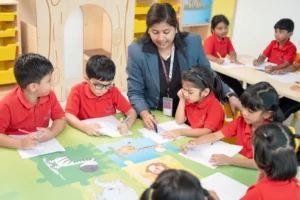
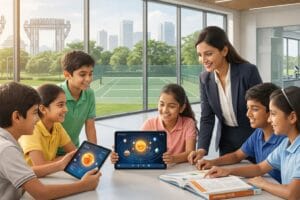
The granite formations of Warangal Urban are hot in the middle of the day, and the Thousand Pillar Temple is full of history. But the humidity is forgotten in a classroom just a few miles away. The walls have come down.
The map is no longer a border for a group of teens in Hanamkonda.
We usually think that you have to leave the district to see the world. The familiar story says that international exposure is a valuable benefit that can only be found in expensive international schools in Hyderabad or Bangalore. That story is no longer true. Cross-border virtual exchange is making exposure more equal. Before the lunch bell rings, a student here can now work with a classmate in Hanoi or Helsinki.
It’s not just a video call. It’s a breakdown of distance.
From Want to Call: The Educator’s Guide
It’s easy to be excited; the hard part is figuring out the details. Teachers often put things off because they see virtual exchange as a tech problem instead of a good way to learn.
To start a program here, stop asking “Which software?” and start asking “Which subject?”
Effective School Leadership knows that a virtual exchange should replace a lesson, not add to the syllabus. If you’re teaching Environmental Science and talking about how to save water, that’s where you start. Curriculum Alignment is needed for the process. We find a partner school, maybe one in a region that has the same problems with drought or flood management, and we make sure that our learning goals are the same.
The technical setup isn’t as important. All you need is a stable 4G connection and a projector. The real need is for a teacher who is willing to work with people in different time zones.
The Handshake Through the Screen
When the connection is stable, the air in the room changes.
There is the unique hum of a Hanamkonda classroom on one side and the calm order of a Japanese school or the chaotic energy of a Brazilian computer lab on the other. The first “Hello” is usually unsure. Local students, who are often very aware of how they speak English, are hesitant.
Curiosity is what makes things happen.
As the session goes on, the screen stops being a wall and starts being a window. We can see how Telugu culture’s warmth mixes with the search for knowledge around the world. It is messy, loud, and very human. The students know that the pixelated shapes on the wall aren’t real-life examples from a textbook. They are friends who don’t like homework, love anime, and are worried about their tests.
The “Doing” Phase: More Than Just Saying Hello
It’s a missed chance if the conversation only goes as far as “Namaste” and “Hola.” A real global classroom needs interactive learning methods that make people work together.
We quickly move into structured work. The SDG (Sustainable Development Goals) Project is one of the best frameworks.
Think of a student from Hanamkonda telling a student in California who is dealing with wildfires how the Mission Bhagiratha water grid works. They’re not just telling each other stories; they’re also comparing data sets. They could do a “Cultural Mystery Box” session, where they describe a local object (like a replica of a Kakatiya stone carving) only by its use and history, and the other person has to guess what it is. It goes beyond just memorizing words.
Finding your way through the Tier-2 world
Let’s not make the infrastructure sound better than it is. Hanamkonda is a Tier-2 city, and that can cause problems.
The electricity could go out in the middle of a presentation. The monsoon could damage the fibre optic cable. The amount of bandwidth changes. Then there’s the “anxiety about accents.” The students here are brilliant, but they don’t always have the same conversational style as students in big cities. They are afraid of making a grammatical mistake.
We fix this by making the glitch normal. We switch to audio when the video stops. We use the chat function when a student has trouble saying a word. We teach them that being able to bounce back is an essential skill for being digitally literate. These aren’t failures; they’re just how things are in the real world.
Making things more democratic.
Most families in Warangal Urban can’t afford to travel internationally. It costs lakhs to join a physical exchange program. The cost of internet bandwidth is what it costs to do a virtual exchange.
This is what equity looks like in action.
Digital bridges get around visa lines and flight costs. In a way, we are outsourcing the travel and bringing the experience in-house. In Geneva, a child of a local merchant can argue about climate policy with a child of a diplomat. The field of play doesn’t just get even; it gets bigger.
The Comparison: Physical vs. Virtual
| Feature | Physical Exchange | Virtual Exchange |
|---|---|---|
| Cost | High (Flights, Visa, Accommodation) | Low (Internet connection, Hardware) |
| Accessibility | Elite/Select few | Scalable to whole classrooms |
| Duration | Short-term (1-2 weeks typically) | Sustained (Semester-long) |
| Carbon Footprint | High | Negligible |
| Skill Focus | Cultural immersion, independence | Digital collaboration, remote comms |
The Engine of Empathy
Textbooks don’t change. They give facts. People are shown through virtual exchange.
When a partner student from Ukraine talks about their school during a conflict, or a student from an island nation talks about rising sea levels, the Hanamkonda student stops studying for the test. The idea fades.
It turns ideas into stories. We see a change from “learning about the world” to “learning with the world.”
More Than Just Words: Real Results
A lot of people who don’t like these sessions call them fancy pen-pal programs. They don’t get it.
Joint deliverables are part of the academic rigour. Students could work together to write a digital magazine by making a shared Google Slides deck. The Hanamkonda team works on it during the day, and the US team picks it up at night (our night). They learn how to work together asynchronously, which is a skill that is essential in today’s economy. They know how to negotiate meaning, handle deadlines across time zones, and give constructive criticism.
Making the Future Safe for Young People
We aren’t just teaching students; we’re also preparing them for jobs in the future.
Check out the job market. Top-tier MNCs want people who can work from home, understand cultural differences without leaving their desks, and use digital tools to solve challenging problems.
A 14-year-old who can confidently present a project to a room full of foreign peers on Zoom will not be afraid to do the same thing in a global business meeting at age 24.
The Lasting Legacy
The video call itself isn’t worth much. It’s the change in your mind.
The student leaves Hanamkonda school through the gates, past the auto-rickshaws and street vendors, but their mental map has changed. They don’t think of themselves as being on the outside of the global conversation anymore. They are taking part. They have realised that their voice carries weight across oceans.
Yes, they live in Hanamkonda. But now, they know they belong in the room.
Frequently Asked Questions
No, basic devices, stable internet, and a committed teacher are enough.
By flexible scheduling or partnering with schools in nearby time zones.
Yes, all sessions are teacher-led, supervised, and institution-approved.
That’s expected and encouraged, as exchanges build confidence through guided intercultural dialogue.