Introduction: From Pedigree to Performance
For decades, the ‘golden ticket’ to a high-paying career was a degree, any degree, from a ‘prestigious’ university. The name on the diploma, the pedigree, often mattered more than the actual abilities of the graduate.
The global job market is undergoing a seismic shift. We’re moving away from credentialing to a more skills-oriented approach. Hiring managers at the best global companies focus less on what institution and more on what candidates can do.
Can you run a Python script? Can you manage a cross-border team across multiple time zones? Can you use AI to improve a marketing funnel? Today, everything is about performance and not pedigree.
The Reality Check: Bridging the Education-Employability Gap
The skyrocketing costs of higher education have not resulted in any ‘education-employability gap’ closing. Many employers, and recent industry reports corroborate this, say that graduates are not ‘work-ready’; they are qualified academically, yes, but are not ready to step into the workforce.
As long as learning institutions have been around, syllabi have been a part of the learning experience, but the ways they have been structured have been a part of the problem. When students learn a set of skills, the school calendar and its rigidity mean that a lot of time is spent learning skills and methodologies that have little to no relevance to the market. It is necessary to make a serious commitment to learning and to build an experience-relevant skill set.
What is Skill-Based Learning (SBL)?
Skill-Based Learning (SBL)* is an educational framework aimed at cultivating competencies and practical know-how, rather than focusing on theory.
An analogy would be the difference between reading the manual for a flight simulator and just getting into the simulator to learn. In a professional context, SBL centres around the specific, high-demand competencies to master a role.
The Benefits of Skills-Based Learning
As the saying goes, theory gives you the framework, but practice adds the rest, and gives you the working parts that make everything function together. Real-world problem-solving is a lot of practice and experience working together, as there is no one right answer, as there is in a classroom.
When a learner partakes in a hackathon, a live internship, or any simulation, they are building the mechanics in a way that textbooks simply cannot give. They learn to fail and pivot; to iterate. And that is exactly the experience that an educator cannot replicate.
Workplace Integration Techniques in Education
To keep their relevancy, both educational institutions and individual learners are adopting new strategies in career-oriented education.
Sandwich Course Models: A program that integrates academic study with a period of full-time work in the industry.
Real World Industry Projects: Curriculum-based projects that require students to resolve business problems for actual organisations.
Guest Mentorships: Students have the advantage of learning from industry professionals who are currently working in the field.
These methods ensure that students are educated and employable. (link) career-focused courses.
Borderless Career Path Opportunities
The global digital economy has created a world with no borders to work. You do not have to live in Silicon Valley to obtain a position with a leading technology company, or in London for a top company in global finance. However, the work needed to square up to these opportunities is universal business language: Competency.
The New Global Currency: Skills
In today’s global economy, your CV or bio is no longer your currency. Your achievements are far more valuable than your education, and your demonstrated experience is more valuable than any educational qualifications.
Soft skills required for international work* serve as a cross-border validation system. Whereas individual countries have different sets of university rankings, being able to handle an Agile workflow or work with Salesforce is the same everywhere. This is why skills can cross any borders without any restrictions.
Borderless employment is now a reality.
More and more companies have implemented “location-agnostic” hiring policies and are now able to find the best talent rather than the closest. This shift has given rise to the specialised ecosystems of talent development through bootcamps and platforms designed for remote international employment.
Strategic Upskilling: What Global Employers Actually Want
For professionals to stay in demand, they need to continuously and strategically upskill. Modern recruiters want the following:
1.Hard Skills: Technology, Data, and AI Proficiency
All about the basic, unmissable skills training* in technology. You do not need to be an engineer, but you need to have:
Data Literacy: the ability to make business decisions from given data.
AI Adaptation: using programs/tools such as ChatGPT, Claude, or Midjourney to enhance your productivity.
Technological Proficiency: the ability to work with collaborative tools (Slack, Asana, Notion) and proprietary software in your industry.
2.Power Skills: The Evolution of Soft Skills
While hard skills land you an interview, “power skills” (formerly soft skills) land you a promotion. Power skills are the globalised workforce’s most valuable skills. Here are some examples:
Cultural Intelligence (CQ): The ability to identify and understand professionally appropriate communication and behaviours in a given culture.
Asynchronous communication: The ability to communicate in writing clearly and succinctly, considering the differing time zones of your colleagues.
Emotional Intelligence (EQ): The ability to understand and cope with the emotional states and tensions of others in virtual team settings.
Micro-Credentials and Workforce Readiness
As the market changes, the way we signal competence is evolving. The traditional four-year degree is no longer the only way to communicate that you are ready to enter the workforce. There has been a rapid increase in workforce-readiness programs, coupled with micro-credentials. Intensive short-term (Google, AWS, Coursera, etc) certifications allow professionals to pivot quickly; a marketer can become a data analyst in 6 months instead of spending 4 years in a degree program.
Contrast of Traditional Education and Skill-Based Learning
| Feature | Traditional Education | Skill-Based Learning |
| Primary Focus | Theory & Knowledge | Competency & Application |
| Duration | 3–4 Years | Weeks to Months |
| Validation | Degree/Diploma | Portfolios & Certifications |
| Adaptability | Slow to update curriculum | Updates in real-time with industry |
| Global Relevance | Depends on school reputation | Universal skill standards |
Conclusion. Build a future-proof career.
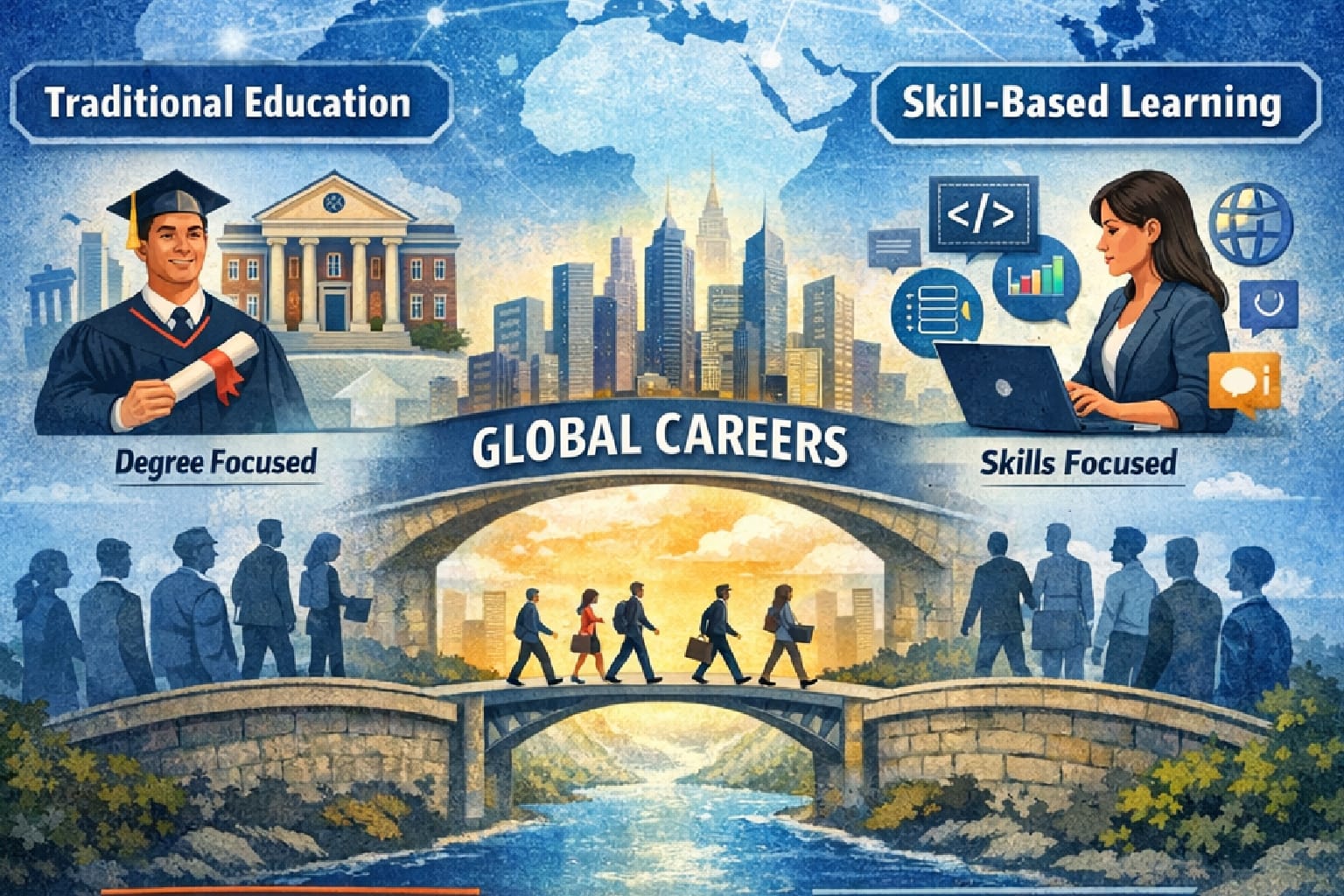
The bridge between the classroom and the global boardroom is built with what you can do, not just what you know. Skill-based learning is a survival mechanism for the modern workforce.
Practising learning modules that emphasise practical application and utilising AI and micro-credentials will unblock global career paths previously restricted by exorbitantly priced degrees. The future will be for the learners, doers, and the skilled.
Frequently Asked Questions
Not yet, but that is the trend. Big tech companies like Google, Apple, and IBM no longer require degrees for many positions to focus hiring on skill over degree.
Rather than listing "responsibilities," state your "achievements." Include a portfolio, GitHub, case study, or evidence of your supposed work.
Gaining respected micro-credentials that international employers value is possible through Coursera, Udacity, and other industry-related bootcamps.
It emphasises digital tool usage, self-management, and asynchronous communication, which are essential for remote and borderless workplaces.