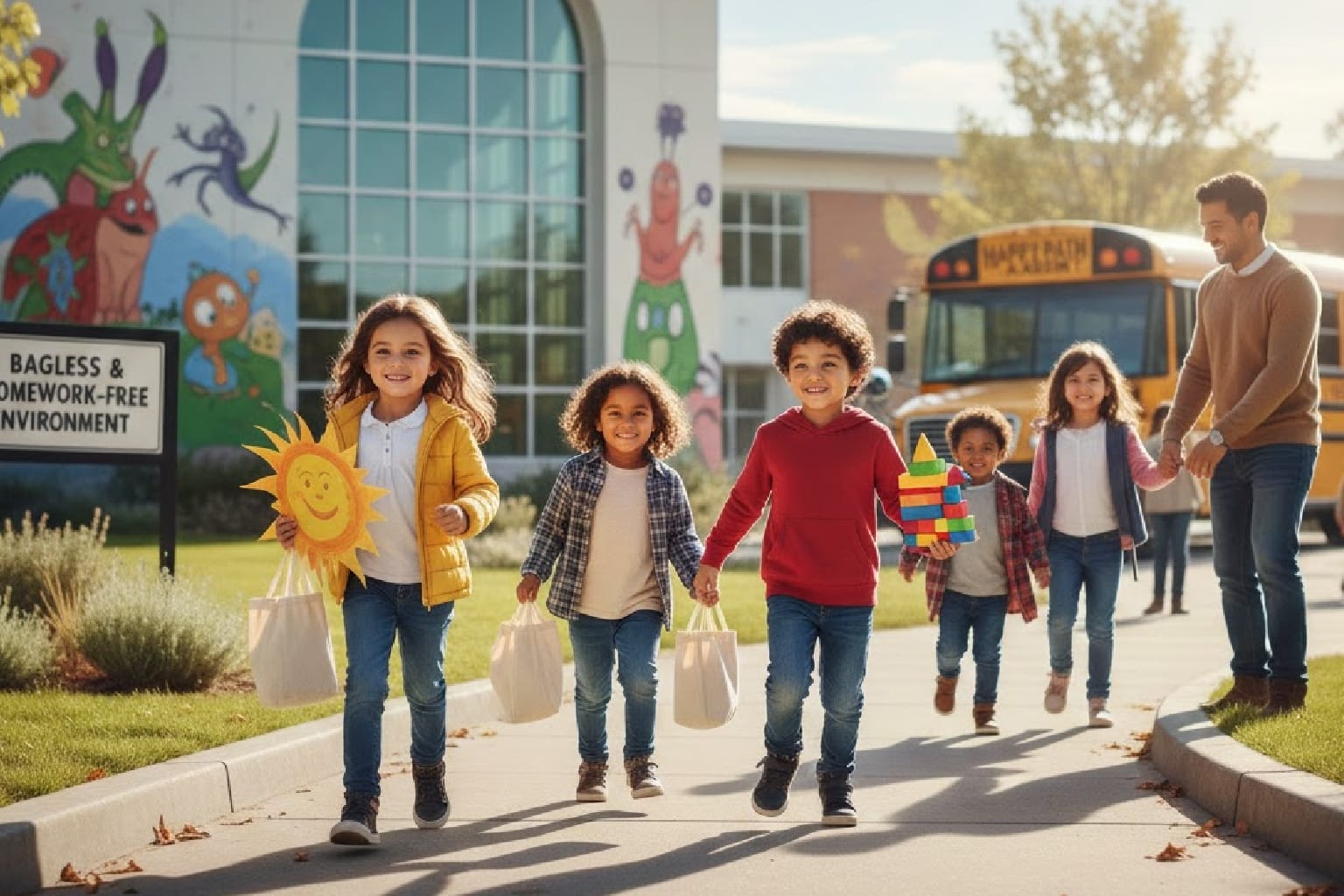
A worrying sight is common at primary school bus stops. Children as young as five or six are seen bending over to try and support the weight of their oversized backpacks. The burden is not only physical, as the school is open extended family time to accommodate for evening homework.
The model has not changed for decades. That is the educational system believes that heavy textbooks and take-home assignments show academic rigor. But on the contrary, educational psychologists and other professionals are saying the exact opposite. A homework and bagless school is not an ecosystem of lowered standards. It is an ecosystem of understanding how young children develop.
Shifting from a school load to a focus on educational engagement creates a load for fostering. It protects physical health creates and shows a genuine lifelong love for learning.
The Physical Weight: Impact of School Bags on Child Development
The Anatomy of a Growing Child
To comprehend the negative effects of heavy school bags, we have to look into the nature of a child’s body. Children are not little adults, and their bodies function differently. For children aged between four and ten years of age, the spine and skeletal system are undergoing a lot of development, mainly ossification, and the spinal muscles are still in development. In addition, a child’s center of gravity is at a different position when compared to an adult or even a teenager.
When children wear backpacks that are more than 10%- 15% of their body weight, they are forced to lean and focus on the front. This may lead to the following overuse:
- Spinal Compression: Stressing the discs between the vertebrae too early
- Postural Deviations: Creating a habit of slouching or “forward head” posture even when the bag is off
- Chronic Pain: There have been a lot of reports of children suffering from neck and back pain as more schools increase the weight of school bags
Positive Effects on the Physical Health of Children With No School Bags
When children do not have bags, their entire school day physical experience is different. In a bagless school, the classroom becomes a self-contained unit. This is because everything that is needed is at school.
This shift saves not only saves a trip to the chiropractor but also promotes better mobility. With less bulky bags, Children are able to sit, stand, and walk straighter. The weight of a bag can negatively impact the development of a child. When a child is physically drained from the weight of a bag, they are unable to fully participate in activities at the playground and in class. When the child’s muscle are not fatigued, they are also able to walk and sit straighter, leading to less trips to the chiropractor and better overall mobility.
Understanding the Bagless School Benefits
Fostering Responsibility Without the Backpack
An argument against bagless schools is that remembering a lunchbox, pencil case, and books teaches responsibility. The argument also states that children are able to manage their stuff by remembering to not only grab their bag but also to complete all of the steps for the bag. In actuality, the responsibility for remembering those things ends up on the parents and turns the morning routine into a stressful checklist managed by parents.
Instead of managing a sack, children manage their surroundings. They set up their own personal lockers or cubbies to store their things. They are responsible for taking things out of the community storage and putting things back. This teaches responsibility for the community and organization, all of which are better lessons in a real world scenario than simply carrying things from one place to another.
Ease and Safety
For the youngest learners, the advantages are immediate and safety-focused. Large bags, and the big preschoolers (who are still developing their gross motor and other key developmental) create tripping hazards and reduce the amount of space available for circle time and active play.
From the preschoolers’ perspective, a bagless school environment is liberating. It divides the “work” of school from the “sanctuary” of home. They are done for the day when they leave the building. There is no school hanging over their head, and no school bag face down on the hallway floor.
Unburdening The Mail: Homework-Free Early Childhood Education
The Myth of Academic Rigor in Early Years
There is a widespread belief that the earlier homework is assigned the more disciplined and academically inclined a child will become. The reality is that research does not support this. Children between the ages of 4 and 10 are on an experiential learning pathway. They are not ready for rote, repetitive learning.
Worksheets that are handed out to children that are 6-years-old will cause more burnout than anything else. After six hours of highly cognitive work, children aren’t going to want to work any more. This often results in frustration, tears, and negativity associated with learning. A central goal in early education is to get children interested in learning, and traditional homework is killing that by making children think of learning as a punishment and chore.
| Feature | Traditional Homework Outcomes | Homework-Free Outcomes |
|---|---|---|
| Evening Dynamic | High stress; Child is forced to comply by parent. | Relaxed; Parent becomes co-pilot. |
| Sleep Quality | Generally lower. | Better with homework-free time schedules. |
| Attitude to School | Seeing it as a mandatory, boring obligation. | Seeing it as a fun, engaging place. |
| Skill Practice | Memorizing and drilling facts. | Functional (e.g., cooking, reading). |
Benefits of No Homework in Primary School
Research shows that there is little, if any, correlation between homework and understanding of a subject in elementary school (Grades K-5). The lack of homework, however, mitigates the damages to mental well-being and family cohesion.
Removing homework reestablishs the “second shift” of childhood: play and interaction with the family. It creates family peace because parents don’t have to argue with children to do homework. This kind of evening reduction in pressure creates opportunities for family activities like reading, cooking, or just relaxing, which do vastly more for a child’s vocabulary and mental health than a homework sheet ever could.
Play Versus Homework: The Fight For Cognitive Development
How Kids Really Learn
Neuroscience has shown that recording new memories and building neural pathways is most efficiently accomplished through sensory experiences and active engagement. While this is often referred to as “play,” it is not as simple as that.
When a kid builds a tower, it’s not just about the construction. They’re experimenting with the laws of physics. When children socialize and work through conflicts during a game, they’re practicing diplomacy and emotion control. This kind of cognitive work is what we want to see for optimal brain development because it stimulates the prefrontal cortex in a way that rote learning and homework never will.
Childrens Development Without Academic Stress
When students do not have to respond to a teacher for a grade, they engage in more advanced forms of thought. Without the distractions of annoying busy work, students focus on understanding more of a concept. Instead of “I have to do this because a teacher said so”, students can focus on “I want to do this because I want to learn”.
This method also fosters motivation within the student. Homework is a gross and uninteresting method that stifles intelligent thinking. When a student is motivated out of their own curiosity, they are more likely to be engaged in the process of learning, and ultimately will take more risks when it comes to asking advanced or difficult questions.
All Aspects of Development in Schools Without Homework
(Getting too serious)
Making Learning Enjoyable and Stress-Free for Students
The social aspect of the students is positively impacted a lot when students do not have to carry heavy bags to and from school. When arriving and leaving school no one is rushing to leave or enter the classroom and they can spend this time actually talking to one another.
The absence of assigned work helps students socialize outside of class too. Students have time to engage in sports and other social activities outside of school. These are massively important for building other essential skills like empathy, negotiation, and patience. Kids who spend hours doing school work do not have as many opportunities to develop these skills.
More and more young children feel anxiety and related to school. This is often related to worries regarding failure – forgetting a book, losing a worksheet, or not completing a task.
Removing learning tools and school work expectations eliminates anxiety triggers. School becomes a safe space for learning. Instead of seeing school as a place for obligations, children can see school for the excitement of learning. This positive experience becomes the most powerful predictor for a child’s future success in school.
Learning Without Bags and Homework
In-class Learning and Mastery, Not Homework
A common worry in a model without homework is the idea that children will not learn the material. This is based on an archaic view that schools are for gaining information and homes are for practicing.
In a model free from homework, it is the responsibility of the teacher to ensure learning and mastery occurs in the classroom. This requires thoughtful lesson preparation that provides practice, application and review to all children. Any child that does not grasp the concept is provided immediate support by a qualified teacher, rather than being left to struggle at home with an untrained parent.
| Responsibilities | Traditional | Bagless/Homework-Free |
|---|---|---|
| Concept Introduction | Teacher Led | Teacher Led |
| Concept Practice | Homework | Practice at School |
| Remediation | Help at Home | Immediate Feedback from Teachers |
| Enrichment | Worksheets | Outdoor Play, Hobbies, reading |
More Responsibilities for Parents in a Homework Free System
Eliminating homework doesn’t take the parent out of the equation, it upgrades their role. No longer do parents have the role of a taskmaster peering over homework, parents shift into facilitators of skills.
In this model, “homework” looks a little different. Parents read bedtime stories (homework). This helps promote literacy. Parents are also encouraged to allow and motivate outdoor play (to develop gross motor skills). Discussing the events of the day helps develop memory and narrative skills.
Investing in a Lighter, Brighter Future
The shift toward a homework free and bagless model is not a retreat from education, it is a new evolution of education. It is acknowledging the physiological limits of the growing body and neurological limits of the developing brain, to create an experience that is effective and sustainable.
As a society, we should no longer measure the quality of education by the weight of the school bag or the volume of homework. Rather, we should measure it by how the child carries their bag, how curious they are about the subject, and how well they can think in an unconstrained manner. A lighter childhood leads to a brighter and more liberated adulthood.
Frequently Asked Questions (FAQs)
Schools share progress through digital portfolios, feedback, and regular parent updates instead of homework.
No, students learn responsibility through organizing lockers, shared resources, and classroom care.
Communication happens through dedicated folders, digital tools, and continuous teacher-parent interaction.
Yes, focus on curiosity and burnout-free learning builds strong long-term academic readiness.
They engage in reading, play, sports, hobbies, and family time that support overall development.