Updated August 2026: refreshed with the latest 2026 NEP implementation updates and how Skill Stork’s Panchkosh approach has evolved.
NEP 2020 in 2026: What Has Actually Changed in Schools
By 2026, NEP 2020’s impact on Indian schools has become concrete. More schools now teach through activity-based and experiential methods, the 5+3+3+4 structure is being phased in across states, and assessment has shifted from rote memory toward competency and application. For parents in Warangal choosing a school, these changes matter: the curriculum your child experiences today is genuinely different from five years ago.
The Panchkosh Vikas framework, rooted in holistic development of the physical, vital, mental, intellectual, and spiritual dimensions, aligns naturally with NEP’s emphasis on developing the whole child. Schools applying this philosophy are seeing benefits in student confidence, creativity, and emotional resilience, not just academic scores. When you evaluate schools this year, ask how they implement experiential learning, not just what textbooks they use.
The education system in India is witnessing unprecedented changes, especially with the implementation of the National Education Policy (NEP) 2020, which prioritizes the transformation of the educational system from mere rote learning to holistic and integrated 360-degree development. It emphasizes `Panchkosh Vikas`, the `Five-fold development of the self`.
At Skill Stork International School, we don’t just comply with educational policies; we live them. We integrate the Panchkosh framework into our innovative curriculum to develop students who are Fit, and who have a well-balanced Mind, and a sharp intellect.
Our Approach: Executing NEP 2020
NEP 2020 is clear in stating that it intends to end the `factory model approach` to education, a model that disregards a child’s individual potential. The value of diversity is covered in Skill Stork’s implementation plan, which merges contemporary global teaching methodologies with the Indian Knowledge System (IKS).
By integrating Panchkosh, we are able to extend learning beyond the classroom to include the sports field, the meditation hall, and even the community. This is what establishes our innovation in education within the city of Warangal.
Panchkosh Vikas in Contemporary Education
A clear understanding of our pedagogy leads to the educational philosophy that guides it. In the Taittiriya Upanishad, the Panchkosh speaks of the five fundamental layers that constitute human existence. These layers are:
Annamaya Kosha (Physical Layer): This layer consists of the body, which is nourished by food (anna).
Pranamaya Kosha (Vital Energy Layer): This layer consists of the breath of life (prana).
Manomaya Kosha (Mental or Emotional Layer): This layer consists of the mind and the emotions (mana).
Vijnanamaya Kosha (Intellectual Layer): This includes wisdom and the powers of discrimination (vijnana).
Anandamaya Kosha (Bliss Layer): This layer comprises inner joy and peace (ananda).
The Five-fold Development model noted in the NEP 2020 is in direct response to the current crisis of high levels of stress and poor physical health in students. Education has to expand beyond the mind and encourage the development of the whole person.
Five Different Actions Resulting in Five Different Outcomes
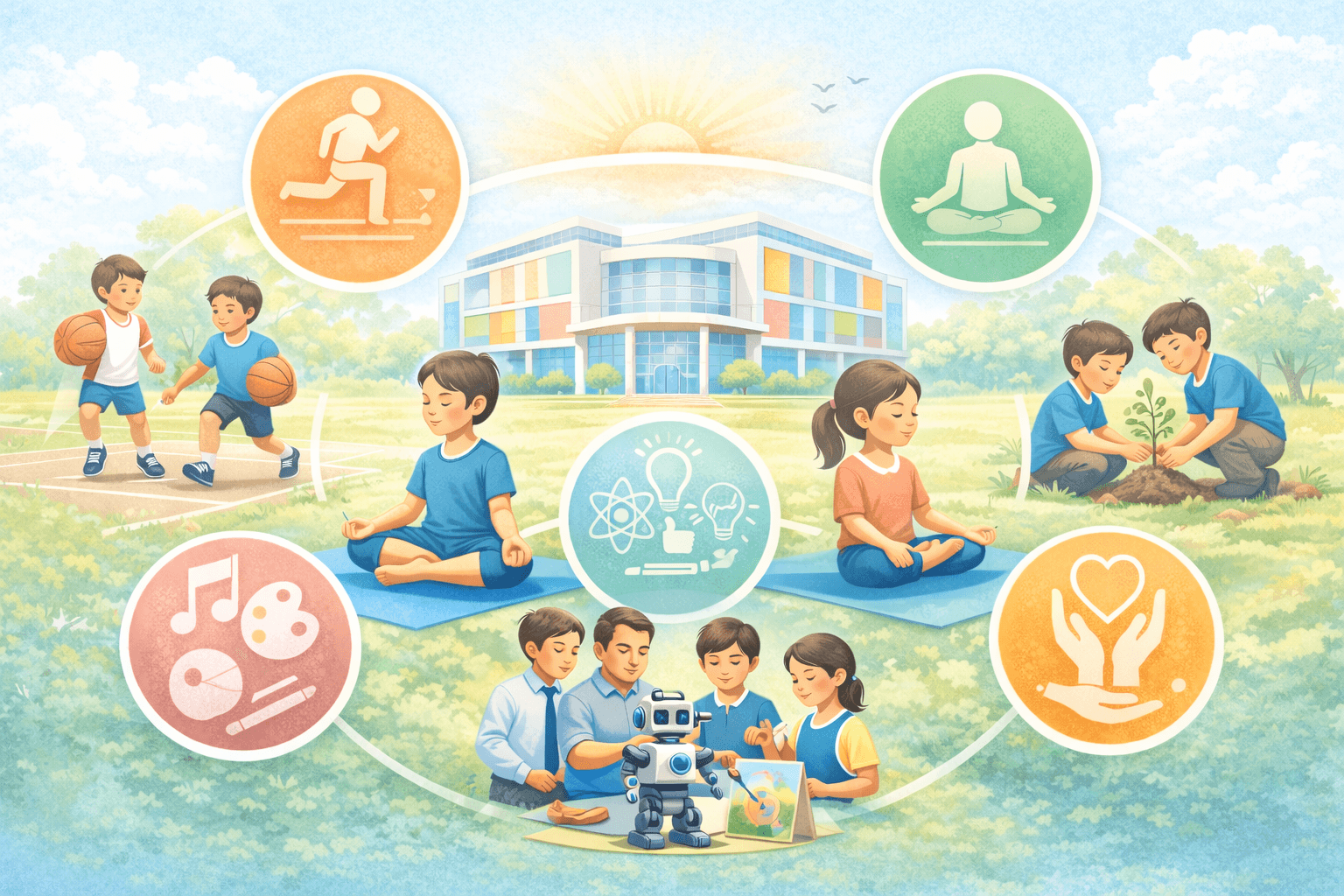
The five layers have been translated into daily activities at Skill Stork.
Annamaya Kosha (Physical Layer)
A strong and healthy body is the foundation of all development. Without it, one cannot focus the mind.
Nutrition: Students are taught about Sattvic diets. The cafeteria plan is designed to provide healthy, balanced, and sufficient meals.
Sports Integration: Physical education is not an elective. Swimming, basketball, and other activities are a part of the daily activities of every single child.
Health Checks: We provide routine health screenings to monitor physical growth and health.
Pranamaya Kosha (Vital Energy Layer)
To pay attention, some energy control is necessary.
Breathwork (Pranayama): The students will learn various techniques to soothe their nervous systems.
Yoga: Not only will students learn yoga, but they will also participate in regular sessions to balance their vital energy so that they are fully present but also fully relaxed.
Mindfulness: Students will have designated scheduled “quiet time” to re-center and, most importantly, recharge their Prana mentally.
Manomaya Kosha (Mental/Emotional Layer)
This layer pertains to all aspects of feelings, perceptions, and mental hygiene.
Creative Arts: There are three streams through which students can emotionally express their feelings: music, dance, and painting. They each offer valuable emotional release.
Emotional (EQ): The students participate in modules on Social Emotional Learning (SEL) to develop empathy, manage conflict, and self-regulate.
Counseling Support: Students have access to professional counselors with whom they can confidentially and freely navigate their personal issues.
Vijnanamaya Kosha (Intellectual Layer)
While the other mainstream educational institutions place all their focus here, we only see it as one piece of the overall picture involving discrimination and judgment.
Inquiry-Based Learning: This is the method of stimulating critical thinking by posing questions rather than my answering questions.
STEM & Robotics: In these tracks, students have hands-on labs in which they apply logic and other scientific principles to solve real-world problems.
Debate and Discourse: This is how we actively encourage students to apply their higher thinking and to refine their their judiciousness.
Anandamaya Kosha (Bliss Layer)
The end goal of education is peace and connection.
The Happiness Curriculum: In these lessons, we discuss and examine the concept of happiness, which ideally is referred to as the absence of worry, rather than the attainment of material things.
Community Service: The students participate in social work in order to experience the pleasure that is derived from helping others.
Values Education: Lessons concerning integrity and compassion connect students to their ethical inner selves.
Integrating Panchkosh: An Experiential Guide
We believe in experiential learning, i.e., learning by doing. The table below outlines how we map activities to the Koshas.
Kosha Layer | Focus Area | Skill Stork Activity | Outcome |
Annamaya | Physical Health | Athletics, Organic Gardening, Nutrition Workshops | Physical fitness & healthy habits |
Pranamaya | Vital Energy | Daily Yoga, Morning Assembly Meditation | Improved focus & reduced anxiety |
Manomaya | Emotional Balance | Theatre, Music, Art Therapy, Library Time | Emotional stability & creativity |
Vijnanamaya | Intellect | Robotics Lab, Math Olympiads, Science Fairs | Critical thinking & innovation |
Anandamaya | Inner Joy | Community Outreach, Peer Mentoring, Nature Walks | Empathy, gratitude & inner peace |
The Impact on Student Learning Outcomes
The results have been tremendous since we aligned our pedagogy with the NEP 2020 Panchkosh model:
Reduced Exam Anxiety: Stress Relief training through Pranayama techniques and breathing exercises has shown positive results.
Higher Academic Retention: When students have a strong(Annamaya) and a stable (Manomaya) mind, they are better able to retain and understand new concepts.
Behavioral Improvements: The positive and values-based education (Anandamaya) model has fostered a calm and peaceful campus.Skill Stork, an Educational Institution in Warangal, Employee Choice.
Why Skill Stork is Warangal’s Leader in Holistic Education
Parents often ask, “Which is the best school in Warangal for holistic education?” The answer lies in the fidelity of implementation.
While most, if not all, schools in the city of Warangal claim to follow the National Education Policy of 2020, Skill Stork International School claimed to have restructured its entire school around this newfound policy. This change has proven institutional pedagogy, philosophy, and culture to center around life-skills development. In addition to breath and mindfulness work, structured physical activities and relaxing wellness activities, the school emphasizes the promise of the Panchkosh Vikas framework. The school has also invested in premium athletic, scientific, and therapeutic technologies.
Frequently Asked Questions
They form the foundation of learning by ensuring a healthy body and well-regulated energy through nutrition, yoga, and breathing practices.
It builds life skills such as stress management, emotional balance, and a sense of purpose.
Sports support physical growth, while robotics, arts, debate, mindfulness, and service activities support mental, intellectual, and emotional development.
NEP 2020 recommends it, and Skill Stork has fully adopted the model ahead of others.